
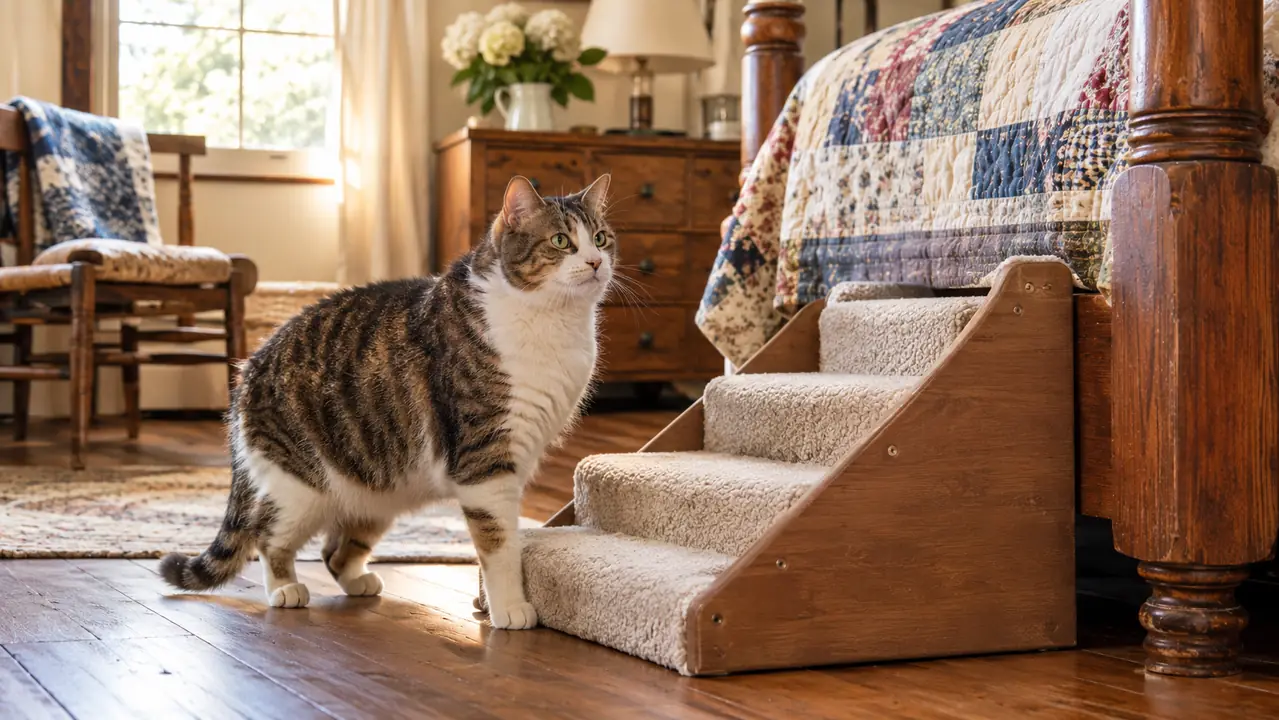
Biscuit is nine years old and about fourteen pounds, and last summer he started doing something that got my attention. He would stand at the foot of our bed upstairs, look up at the quilt, and then just stand there. Not hurt. Not crying. Just doing the arithmetic and deciding it was not worth it.
Our bed is tall. The mattress sits on a box spring on an old frame Ray rebuilt years ago, and the top of that quilt is a long way up for a cat who is not as springy as he was at four. He was still getting up there. It just took him two or three tries, and some nights he would quit and sleep on the cedar chest instead. By August there was a set of Aechonow 3-in-1 pet stairs sitting against that chest, and this guide is the setup that made them work.
At his checkup that summer our vet said he was a little stiff for his age, nothing diagnosed, and that making the climb easier was a reasonable thing to do. That is the whole of my medical advice, and it came from a licensed vet, not from me. If your cat is limping, losing weight, or avoiding the stairs entirely, that is a vet conversation before it is a furniture conversation. What follows is the furniture conversation. The Aechonow stairs did not need to be complicated. They needed to be placed correctly, and the placement is the part I want to walk through in order.
The stairs Biscuit uses every night, sitting against the cedar chest
Three steps, a cave underneath, and a base wide enough that Ray did not have to strap it to anything. Check the current listing for dimensions before you order, because your bed is not our bed.
Amazon Check Today's Price on Amazon →Step 1: Measure the gap before you order anything
I am going to start here because it is the step people skip, and it is the one that decides everything. Do not order stairs by looking at your bed. Order them by measuring it. The listing for the Aechonow stairs gives the dimensions as 19.3 inches long, 11.8 inches wide, and 18.9 inches high, with three levels. That 18.9 inches is the number that matters. It is the height of the top landing, which means it is the height your cat's front paws need to reach comfortably from the top step to whatever comes next.
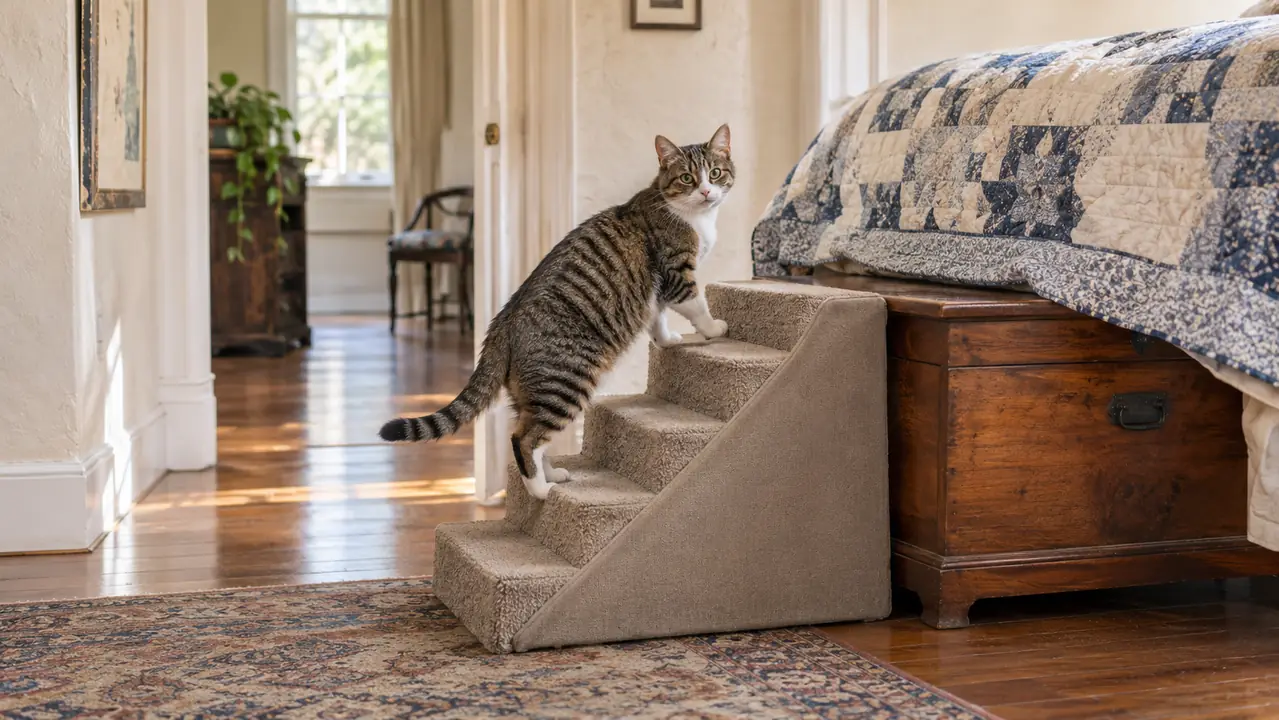
So I took a tape measure and found the height of our quilt top from the floor. Then I subtracted 18.9 and looked at what was left. In our room, the stairs do not go straight to the bed. They sit against the cedar chest at the foot of the bed, and Biscuit walks up the three steps to the top landing, steps onto the chest lid, and from there steps onto the quilt. That is two short hops instead of one long jump, and the second hop is nearly flat. If your bed is lower than ours, the top of the stairs may land you right at mattress height, which is easier. If your bed is higher, you need something in between, and a cedar chest, a bench, or a low ottoman does the job. What you do not want is a top landing that leaves your cat still looking up at a gap. That is the same arithmetic he was already refusing to do.
One more measurement: the width. Eleven and eight tenths inches is the footprint, and the baseplate the listing describes is 19.2 by 11.8 inches. That base is wider than the top of the unit, on purpose, and it is why the thing sits flat. Give it that much floor. Do not try to tuck it into a slot narrower than the base, because then it is on the rug edge or on a baseboard and it will rock.
Step 2: Put it together on a bare floor, not on carpet
The Aechonow arrives with an instruction manual, and I read it, because that is the arrangement in our house. Ray drills. I read the sheet and hold the level. Assembly is not a project. The unit is 11.16 pounds, which is light enough that I carried it up the stairs myself without asking for help. But light also means it will move if you build it on a soft surface, so assemble it on the bare floor. Ours went together on the wood floor of the upstairs hall, on a Sunday afternoon, and I checked the base was sitting on all four corners before I did anything else.
The reason I care about that is simple physics and it is the same reason I care about a bookshelf being level. If you tighten everything down while the unit is sitting on a thick rug with one corner sunk in, you have built in a wobble. Then you carry it to the bedroom, set it down, and the wobble is still there. Build it flat, check it flat, then move it.
The listing describes three ladders, a cat cave that measures 12.9 by 10.8 inches, and scratching posts that are 6 to 7 inches high. I want to say something about those posts, because the listing specifically calls them out as suitable for older cats or chunky cats going up and down. In our house, the low posts are the reason Biscuit's route works. He is a big cat, and a stair unit with tall posts underneath would mean he has to step over something. He does not have to step over anything here. He steps up, up, up, and across. June uses the posts for actual scratching, which was not the plan but is a nice bonus.
Step 3: Level the base and check that the top does not shift
Once it was in the bedroom against the cedar chest, I did the push test. Both hands on the top landing, push toward the bed, then push sideways. A properly seated stair unit should not walk across the floor. The Aechonow base is the reason ours does not. The baseplate is 19.2 by 11.8 inches and the unit is floor mounted, so the weight sits low and wide rather than up high on legs. On our wood floor it does not slide. On a slick floor, or on a hard rug with a finished backing, you may find it creeps a little, and a thin rubber pad under the base is a reasonable fix that costs almost nothing.
Here is the part I would tell anyone, and it is not about this product specifically. If your stairs sit at the foot of the bed and the top landing is free standing, a cat launching off the top landing at three in the morning can tip it. Biscuit is fourteen pounds and he does not launch, he descends like a gentleman, so ours is fine as it sits. If you have a younger, faster cat who will use the stairs as a springboard, put the top landing against something solid. Ours backs onto the chest. That is enough. I am not going to tell you the stairs cannot tip. I will tell you that ours has not, in three months of nightly use by a fourteen pound cat, and that the chest behind it is doing real work in that sentence.
Then let the unit sit for a day before you decide anything. Cats are suspicious of new objects, and a new object that smells like a factory and appeared in their bedroom overnight is a lot to process. Do not stand there tapping it and coaxing. Set it up, walk away, and let them investigate on their own schedule. June was on it within the hour because June is three and goes up anything. Biscuit took four days.
Step 4: Teach the route with treats, not with carrying
Four days is longer than I expected, and I made one mistake in the middle of it, which was picking Biscuit up and setting him on the second step. He got off immediately and would not go near the stairs for the rest of that evening. Do not do that. Being placed on a thing is not the same as choosing a thing, and a cat who has been picked up and deposited learns that the object is where the hands happen.
What worked was the oldest trick there is. I put a treat on the first step. Then, once he took it, on the second. Then on the top landing. Then on the chest lid. Then, and this is the important one, on the quilt. Four treats, four steps, one destination. He did the whole route for the first time on a Thursday evening in August and then sat on the quilt looking pleased with himself.
If you have a cat who is food motivated, this takes about ten minutes spread over an evening. If you have a cat who is not, use whatever your cat will actually cross a room for, and if the answer is nothing, use a wand toy and lead him up. What you are doing is not training. You are showing him a route he did not know existed. Once he knows it, the stairs become furniture, and furniture does not need to be taught.
Four treats, four steps, one destination. He did the whole route for the first time on a Thursday evening in August and then sat on the quilt looking pleased with himself.
Step 5: Make the landing safe and then leave it alone
The last step is the one nobody writes about, and it is where the falls happen. Look at what is on the other side of your top landing. If the route from the landing to the bed involves a gap, a soft mattress edge that gives way, or a sliding quilt, fix that before you encourage the cat up. In our room the chest lid is firm and the quilt is tucked, so the step across is short and level. If your setup ends with a jump onto a loose comforter, the cat is not really any safer than he was jumping from the floor, he has just been given a false sense of confidence at a higher elevation. Tuck the bedding. Move the chest if you have to. A nonslip mat on a slick chest lid is cheap insurance.
Then leave it alone. Do not move the stairs to vacuum and put them back a foot to the left. Do not rearrange the bedroom furniture in a way that changes the route. A senior cat builds a map, and moving the map is the fastest way to lose the habit. Ours has not moved since August, and I am not planning to move it.
And keep an eye on the cat, not the stairs. If he starts skipping the stairs and going back to the jump, that tells you something changed, and it is a vet question. If he uses the stairs but still hesitates at the top, your landing height is wrong and you should go back to step one with the tape measure. The stairs are the tool. The cat is the information.
What Else Helps
The stairs are one piece of a decent setup, and there are a couple of other things worth doing in the same week. A firm surface at the foot of the bed. Our wood floor is fine, but if your stairs sit on a thick pile rug, the base sinks and the whole unit leans. Put a thin, firm mat under the base or take up the rug at that corner. You want the baseplate sitting on something that does not compress.
A light. This sounds silly and it is not. Older cats do not see as well in the dark, and a cat navigating unfamiliar steps at two in the morning is a cat who may just skip the trip. A small plug-in night light in the bedroom costs very little and does more for nighttime mobility than any piece of furniture. We have one on Ray's side of the room and it went in the same week as the stairs. And a word about scratching. The Aechonow has those 6 to 7 inch posts built into it, which is convenient, but June has her own post at the end of the sofa and she still uses it daily. Do not take away a scratching post because a stair unit has one. Cats want options and they want their own smell on things.
One more: watch the weight. I am not a vet and I am not going to give advice about your cat's weight. What I will say is that the listing calls these steps suitable for older cats or chunky cats, and that a fourteen pound cat goes up ours without any creaking or give. If your cat is larger than that, check the listing and use your judgment, and if your vet has said anything about weight, that conversation outranks anything I can tell you about furniture.
Three steps, a cave underneath, and a base wide enough to sit still
The Aechonow stairs are what Biscuit uses every night to get onto our bed. Measure your gap first, then check the listing dimensions and see whether the numbers line up with your room.
Amazon See the Aechonow Stairs on Amazon →I have written up the full long-term experience with these stairs separately, including what has worn and what has not after three months of nightly use, and I compared them against a ramp for anyone still deciding between the two shapes. Both are worth a read before you order, because the honest answer is that stairs and a ramp do different jobs and the right one depends on your cat's shoulders and your bedroom.
Who This Is For
This setup is for the person whose cat has started pausing. Not limping, not falling, just pausing and doing that arithmetic. It suits a bed, a sofa, or a windowsill that is a bit too high for a cat who used to manage it easily, and it suits an owner who is willing to measure before ordering and to spend an evening with a handful of treats. It also suits a multi-cat house where one cat is older and one is younger. June uses the cave as a sleeping spot and scratches the posts, which means the unit earns its floor space even when Biscuit is asleep on the quilt. That was not something I planned for and it turned out to be the reason I do not mind the footprint.
Who Should Skip It
Skip the stairs if your cat is showing real signs of pain, or if there has been a change in appetite, litter box habits, or willingness to move. Those are vet appointments, and no piece of furniture substitutes for one. Skip it if your bed is very high and you are not willing to add something in between, because stairs that end in midair have not solved anything. Skip it if your floor space at the foot of the bed is narrower than the 19.2 by 11.8 inch baseplate, because a unit jammed against a baseboard will rock and you will both be unhappy. And skip it if what your cat actually needs is a gentle slope rather than steps. A fourteen pound cat with stiff shoulders may do better on a ramp than on three distinct levels, and that is a real difference worth thinking through. In our house the steps work because Biscuit's hesitation was about height, not about lifting his feet. Your cat may be telling you something different.