
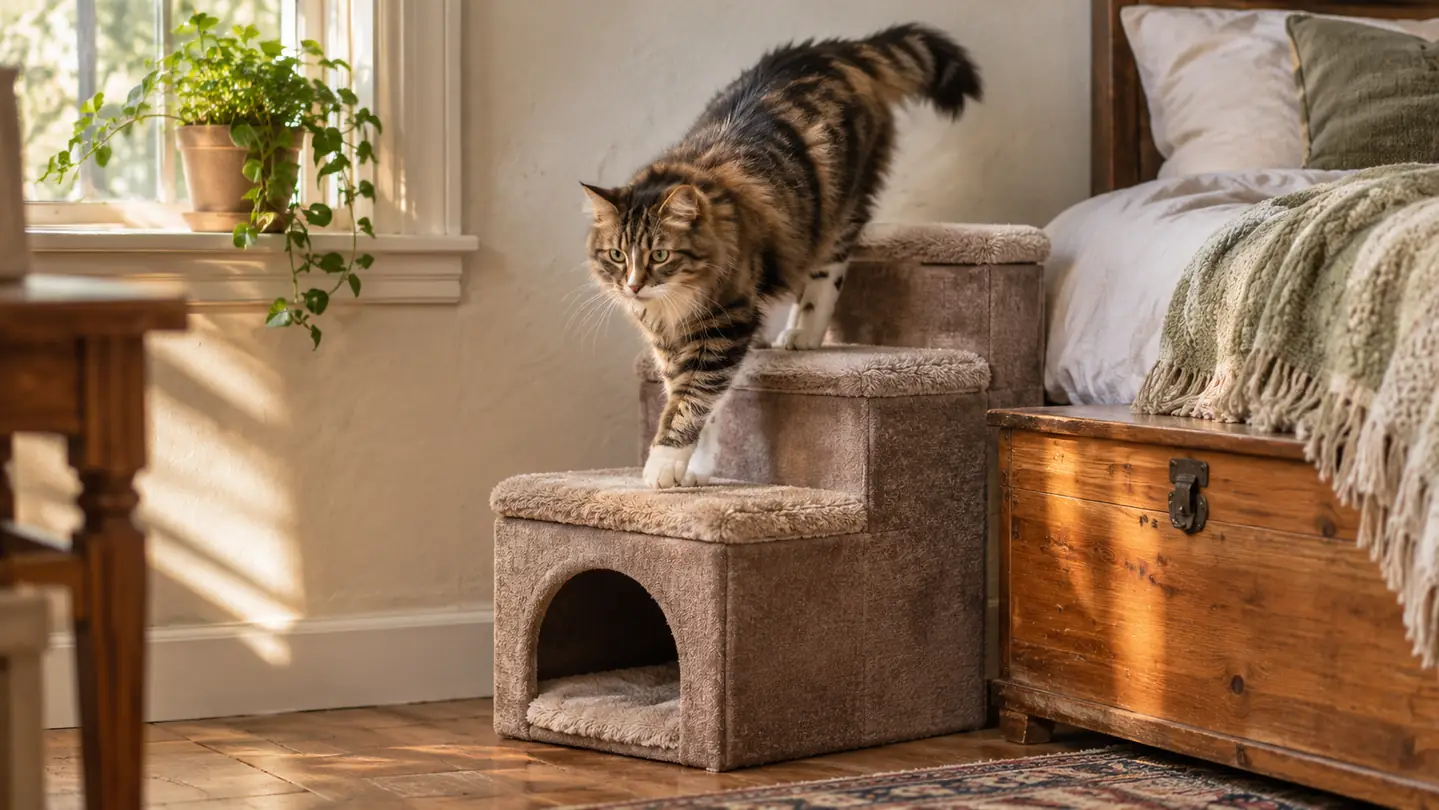
Here is the short answer, before the long one. If your cat is still willing to move but the jump has gotten risky, a set of steps that hold still is usually the easier sell. If your cat cannot or will not lift a foot that high, or if the height you need to cover is long and shallow, a ramp is the better shape. Everything past that is room geometry.
We bought the Aechonow 3-in-1 Pet Stairs in August, when Biscuit, our nine-year-old orange tabby, started stopping at the foot of our bed and thinking it over instead of just going up. The Aechonow stairs sit against a cedar chest at the foot of that bed now, and he climbs them every night. I have not owned a ramp. I considered one seriously for about two weeks, measured our floor twice, and I will tell you exactly why the stairs won in our house and when I would have gone the other way.
| Aechonow Pet Stairs | Pet Ramp | |
|---|---|---|
| Shape of the climb | Three separate levels, each a foot placement the cat makes on its own | One continuous slope the cat walks up without lifting a leg |
| Footprint on the floor | The listing gives a 19.2 by 11.8 inch baseplate, so it wants a compact patch of floor | Needs a long run of floor proportional to the height, which is the whole tradeoff |
| Stability on a slick floor | Weight distributed down through a wide baseplate with a low center of gravity | Depends almost entirely on how the top edge is secured and whether the foot has grip |
| Getting on and off the bed | The cat lands on a level surface at the top, which is easy to step off | The cat arrives at the top edge at an angle, which some cats dislike |
| Cats who cannot lift a leg | A cat has to clear each step, roughly six to seven inches per the listing | The only option that asks nothing of the hind legs at all |
| Very tall furniture | Height is fixed, so a very tall bed may need a chest or ottoman as a landing | Length can be extended to reach taller surfaces without an intermediate landing |
| What else it does | A 12.9 by 10.8 inch cave at the base plus scratching posts built into the sides | Nothing. It is a slope and that is the entire product |
| Where it looks at home | Reads as cat furniture, so it fits in a bedroom or den without apology | Reads as a mobility aid, which some people prefer discreet and some do not |
| Assembly | Listing includes an instruction manual, and it arrives as flat parts | Usually one or two pieces, often folding, so setup is minimal |
| Best for | A cat who still climbs but needs the jump broken into smaller pieces | A cat who needs a continuous path with no lifting at all |
Where the Aechonow Stairs Win
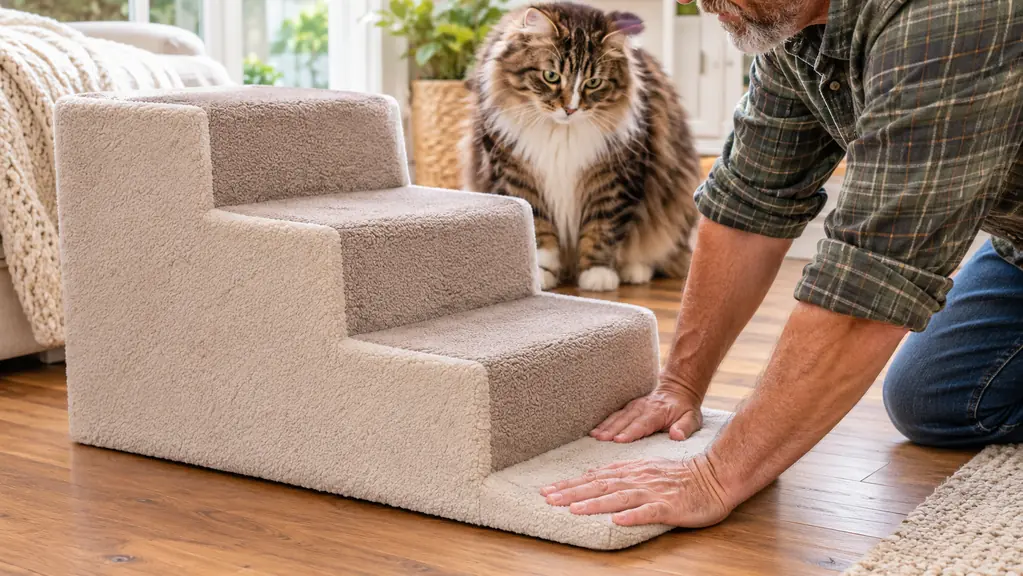
The baseplate is the reason I bought it. The listing puts the baseplate at 19.2 by 11.8 inches and the whole unit at 11.16 pounds, and the weight sits low because the cave is at the bottom. That combination matters on old wood floors. Our farmhouse is 1890s in the front half, and nothing in it is truly level. A ramp resting on a floor like ours has one contact point that matters, the top edge, and if that edge shifts the whole slope shifts with it. The Aechonow stairs have a footprint. Ray set them down, I pressed the baseplate with the flat of my hand, and there was no rock. I have not had to re-set them since August.
The second thing, and I did not expect to care about it, is that a cat arrives at the top of a step onto a flat surface. Biscuit steps onto the chest lid, which is dead level, and then walks onto the quilt. That transition is boring, and boring is what you want. A ramp delivers the cat to the top edge at an angle, and the surface he steps onto is whatever the ramp happens to be leaning against. Some cats handle that fine. Ours is a cautious animal about edges, and I think he would have balked at arriving sideways.
The third thing is that it earns its floor space. Our bedroom is not large, and a ramp long enough to reach our bed would have run most of the way across the room. The Aechonow unit sits against the chest and reads as a small piece of cat furniture, which it is: the listing describes a 12.9 by 10.8 inch cave and scratching posts on the sides. June, who is three and does not need help with anything, sleeps in that cave. I did not buy the stairs for her. I am still glad they are not an eyesore.
Assembly deserves a paragraph, because I know some of you are already wincing. It arrived flat, in pieces, with the instruction manual the listing mentions. Ray and I put it together on a Saturday morning in August at the kitchen table, and it took us under an hour with coffee going. The hardware came bagged and labeled, the pieces went together in the order the sheet listed, and nothing required a second set of hands for more than a minute. June supervised from the top of the refrigerator, which is her contribution to every project in this house. Ray's one complaint was that he would have preferred slightly longer screws, which is his complaint about every flat pack piece of furniture we have ever bought. As built, the unit stands 18.9 inches tall overall, and that number landed almost exactly level with the lid of the cedar chest. That is not a coincidence I engineered. I got lucky, and I would rather admit that than pretend I planned it.
What I Liked
- Wide 19.2 by 11.8 inch baseplate sits flat on uneven old floors without rocking
- Cat lands on a level surface at the top instead of an angled edge
- Steps break the climb into pieces, roughly six to seven inches each per the listing
- Cave and scratching posts mean the piece gets used by cats who do not need it
- Assembles from flat parts with the included instruction manual, and the listing carries a two year manufacturer warranty
Where It Falls Short
- Height is fixed, so it does not reach a very tall bed without an intermediate landing
- A cat must be able to lift a foot clear of each step
- Takes up a floor patch at the base, which a ramp does not need in the same way
- Weighs 11.16 pounds, so it is not something you slide around one-handed
A ramp is one long decision for the cat. Stairs are three small ones, and a cat who is only a little stiff can still say yes to a small decision.
Where the Pet Ramp Wins
I want to be straight with you, because I nearly bought one. A ramp asks nothing. There is no foot to lift, no edge to judge, no middle step to commit to. For a cat whose hind end is genuinely weak, or one who has stopped climbing altogether, the ramp is the only shape on this list that works. That is not a small thing. In our case Biscuit was still climbing, just more slowly and with a pause first, so the stairs matched where he actually was.
The second place a ramp wins is height and length. Our bed is tall, tall enough that we use a chest as an intermediate landing. A ramp can be bought long and shallow and can reach a surface in one continuous run with nothing in the middle. If your cat will not use an intermediate platform, and some will not, that continuous run is not a preference, it is the requirement. I would also give the ramp the edge on discreetness if that matters to you. A ramp can be slid under a bed or folded away. The Aechonow unit is furniture and stays out.
Here is what the measuring actually looked like, because it was not a five minute job. Our bed sits high and the cedar chest at its foot is roughly knee height. I took the tape out on a Sunday afternoon in July and worked out that a ramp from the floor to the chest lid, at a slope shallow enough that a stiff cat would actually use it, would need a run of floor somewhere around three feet, and then a second ramp from the chest lid up to the mattress. Our bedroom has about eighteen inches between the chest and the dresser. That was the end of the ramp in that room, and it was arithmetic, not taste. What I did not want was to buy a long ramp, set it steep to make it fit, and then watch Biscuit look at it once and walk away. A steep ramp is worse than no ramp, in my opinion, because it teaches the cat that the new thing is not worth trying.
If your cat still climbs but has started pausing first, this is the shape that matches
The Aechonow 3-in-1 has a wide baseplate that stays put on old floors, three levels, and a cave at the base that cats who do not need stairs will claim anyway. Ours has been at the foot of the bed since August.
Amazon Check Today's Price on Amazon →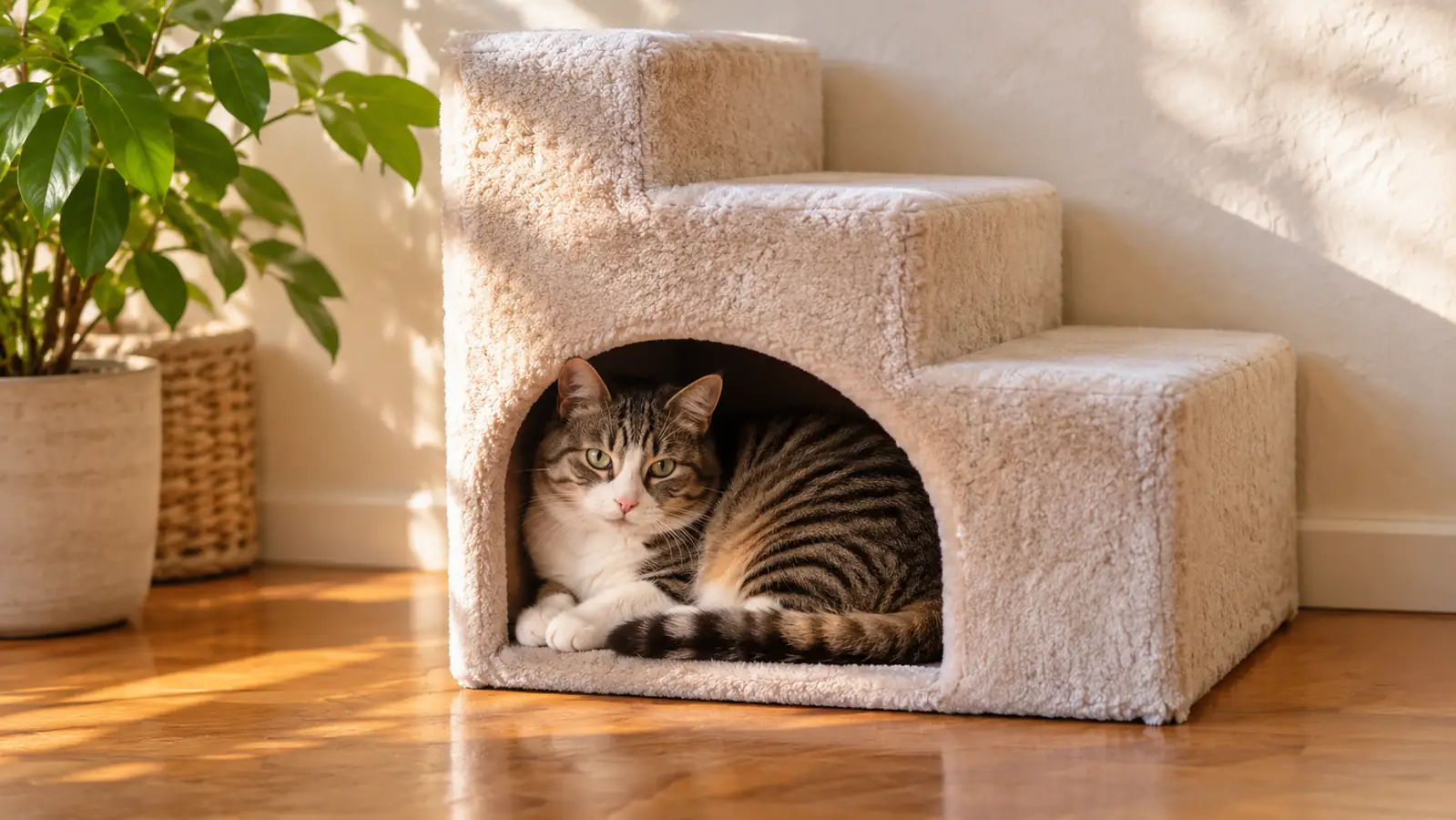
How I'd Decide in Your House
Watch your cat at the piece of furniture in question for two or three days before you buy anything. What matters is whether the animal still goes up. If the answer is yes, and the only change is a pause or a slower approach, stairs are the gentler transition because they keep the climb he already knows and just cut it into smaller pieces. If the answer is no, if he has stopped trying, do not buy stairs and hope. That cat needs a continuous path, and that is a ramp, and it is worth talking to your vet about the change before you spend anything.
Since I said to watch first, here is what the watching looked like in our house. Through June and into July, Biscuit would come to the foot of the bed around ten at night, sit down, and look up at the quilt for a beat before he jumped. He never missed. He just began weighing it, and once or twice he turned around and slept on the floor instead. That pause is the whole reason I went looking. A cat who weighs a climb is a cat who will eventually decline one, and I would rather put steps down before that happens than after. The stairs did not make him quicker. They took the weighing out of the evening, which is a smaller and more useful thing.
Then measure, and measure the floor, not the furniture. The Aechonow baseplate wants a patch of floor about 19 inches deep and 12 wide, and it needs to sit against something at the top so the cat has a level place to step off. In our room that something is the cedar chest. If you have nothing at the top, factor in an ottoman or a low bench, because a cat stepping off the top step into open air will not use the stairs twice. For a ramp, measure the horizontal run you can actually spare. Most people find they have less than they thought, and that is usually the moment the decision makes itself.
A word on the floors, since this is an old house and it comes up. We have original wood floors in the front of the house and newer flooring in the back addition, and neither is what I would call level. The Aechonow unit has not needed a shim or a rug under it. If you are on tile or a slick laminate, put a thin mat underneath regardless of which shape you choose, because grip at the base is the whole game and it costs you nothing to add. I would also check the top of whatever you are climbing to. A chest lid that lifts is fine if it is heavy and sits flush. A chest lid that rocks is not, and you will find that out on the first night.
Who Should Buy Which
Buy the Aechonow stairs if your cat is still climbing but the jump has gotten big, if your floors are old or uneven, if the furniture has a level landing spot at the top, and if you would rather the piece look like cat furniture than like equipment. Ours has held its place against the cedar chest since August without a wobble, Biscuit uses it every night, and June has claimed the cave, which I did not plan and do not mind.
Buy a ramp instead if your cat has stopped attempting the climb, if the hind legs are weak enough that lifting a foot is the problem, if the surface you are reaching is very tall and you cannot put a landing in the middle, or if you need something you can move out of the way. A ramp is also the answer if your cat is a large one who will not tolerate a narrow step underfoot, since a ramp gives a continuous surface rather than a series of small ones.
One more item that belongs in the decision rather than in a footnote: the listing carries a two year manufacturer warranty, which is longer than I expected on furniture in this category. That does not change how a cat feels about a step. It does tell you something about how the maker expects the joints to hold up. After four months of daily use by two cats, one of whom treats the outside of it as a racetrack, nothing has loosened and the covering on the levels has not started to lift at the corners. The cave at the base is where June sleeps most afternoons now, which was never part of my plan. That is the sort of thing I look for these days, because I have thrown out enough wobbling cat furniture to be tired of it.
And if you are somewhere in between, which is where most of us actually are, start with the cheaper and simpler of the two in the room you already have. You can always add later. I am not a vet and I do not play one here. If your cat is stiff, limping, or has stopped jumping entirely, that is a conversation with your own vet before it is a conversation with a shopping cart, and I mean that plainly.
Three levels, a cave, and a baseplate that does not rock on an old floor
The Aechonow 3-in-1 Pet Stairs sit against the cedar chest at the foot of our bed. Biscuit walks up to the chest lid and steps onto the quilt. It is the least dramatic purchase I have made for these cats and the one that gets used most reliably.
Amazon See the Aechonow Pet Stairs on Amazon →