
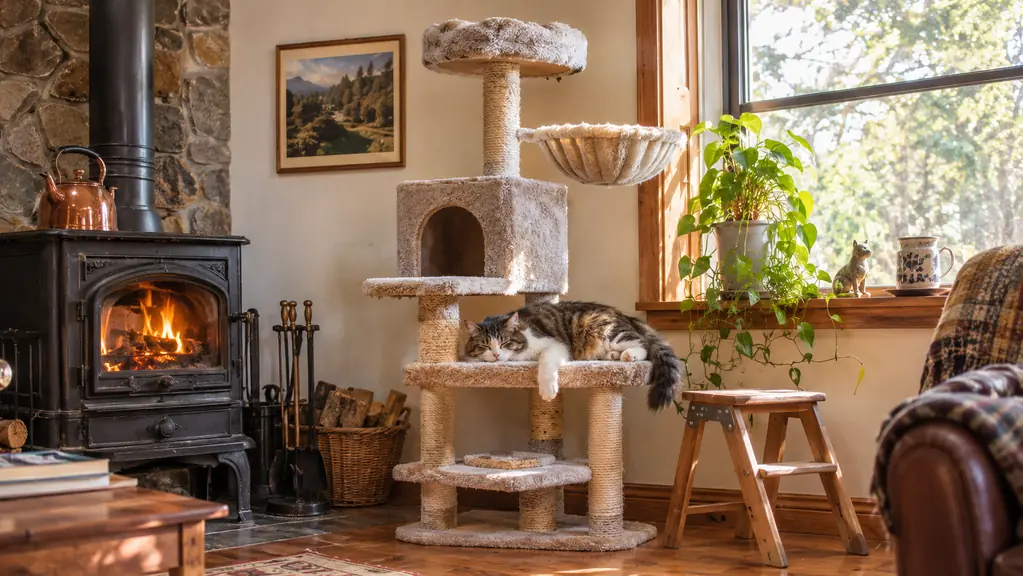
The Heybly Heavy-Duty Cat Tree is the third thing that has come into this house for the cats, and it is the first one I did not have to talk myself into. June had already worn the old carpeted post down to the backing by the end of February, and she had started using the arm of the sofa as a substitute. Biscuit is nine and about fourteen pounds, and he had begun taking the stairs a little slower than he used to. What I wanted was a tall thing June could climb and a wide thing Biscuit could lie flat on, in the same piece of furniture, without it walking across the floor every time one of them jumped off it.
Which is how the Heybly ended up in the corner of the den in the back addition, near the woodstove, in March. It is the room both cats already used in the evening, and it has drywall rather than the old plaster, which mattered later when Ray wanted to put a screw into something. I am not a vet and I am not a cat behaviorist. What follows is what I actually did with this tree over eight months, what the listing says it has, and where it has held up and where it has not.
The Quick Verdict
A genuinely stable five-level tree with a base wide enough for a big cat to land on and enough scratching surface that ours left the sofa alone. The top perch is small, and the wall strap that made Ray relax is not in the box.
Amazon Check Today's Price →35.49 pounds, a 21.65 by 17.72 inch footprint, and 5 levels: here is the Heybly we actually live with
The numbers that decided it for us are the ones in the listing: 64.17 inches tall, 5 levels, 7 sisal scratching posts and 1 scratching board. Today's price and stock are on the product page.
Amazon Check Today's Price on Amazon →How I've Used It
We assembled it on a Saturday afternoon in March. It took the two of us about an hour and a half, and most of that was me reading the sheet out loud while Ray held pieces. The box is 35.49 pounds, so it is a two-person carry up a porch step, not a one-person carry. The parts were labeled and the hardware came in a divided tray, which I mention because the last flat-pack thing we bought had the screws loose in the bottom of the box.
Ray does the drilling in this house and I do the leveling, and that division of labor held here. The floor in the back addition is old wood and it is not level anywhere, so we set the base where the boards were closest to flat and shimmed nothing. It sat solid. The listing describes a fully widened frame and a wide base, and I can tell you what that looks like in a room: the footprint is 21.65 by 17.72 inches, and the weight sits low, so the thing you are pushing against when you bump it is the floor and not a narrow post.
It has been in the same corner since March. Nothing has been retightened except once, in June, when I went around with the Allen key out of habit and found two of the bolts on the upper section maybe a quarter turn loose. The sisal has not unwound. The faux fur on the platform Biscuit uses most has flattened where he lies, which is what fabric does. The engineered wood underneath has not swelled or chipped, and I vacuum the platforms weekly without anything coming apart.
What Went Together Well, and What Took Longer
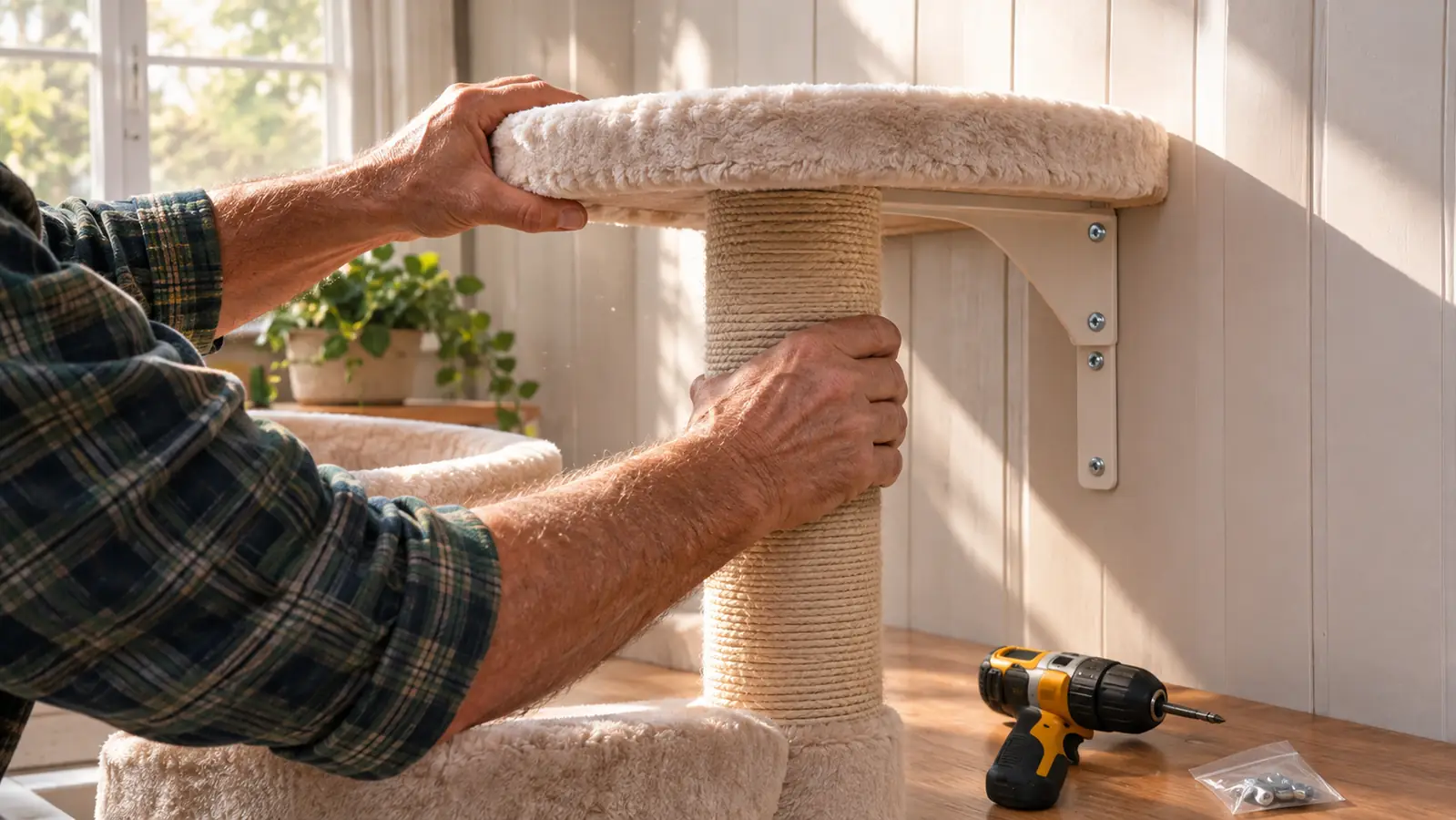
The tower went together faster than I expected. The five levels stack in a way that lets one person hold while the other drives, and the pieces are big enough to see which way they face. What took longer was deciding where it went. A 64 inch tree in a room with a woodstove has to sit far enough back that a cat landing off the top perch does not land on the stove, and close enough to the wall that the upper section can be tied off.
The one thing I would tell anyone assembling this: put it where you can reach the top with a step stool, because you will want to check those upper bolts once. Ours sits in a corner, which let us use two walls as a reference for square. If you are putting it out in the middle of a room, the base is wide enough to be steady, but you are relying on the base alone and not on a wall.
The listing says the tree combines a condo, pom-poms and sisal rope toys, and all of that was in the box. The pom-poms hang and June bats them. The condo is on a lower level and both cats have used it, though Biscuit uses it more. Nothing was missing and nothing needed a trip back to the hardware store, which given our history with flat-pack is worth saying out loud.
Stability, and the Strap We Added Ourselves
I want to be clear about this part, because it changes what you are buying. The tree is stable on its own base. It has not tipped in eight months, and June hits the top perch at a run. But a 64 inch piece of furniture in a house with a cat that launches off the top of things is a tipping risk in the abstract, and Ray did not want to think about it. So he bought a plain furniture anti-tip strap at the hardware store and screwed it from the upper section of the tree into a wall stud. That strap is not part of the product. It is not in the box. If you want that extra tie-off, you buy it yourself.
The screw went through drywall and into a stud, which is why the tree is in the back addition and not in the front room, where the walls are original plaster over lath. I would not trust a plaster wall to hold a strap like that. If your house is all old plaster, plan for the base to do all the work, or find a corner where a stud happens to be where you need it.
With the strap on, the whole assembly feels like part of the wall. Without it, it felt like a tall bookshelf: fine, until somebody does something foolish. I am not going to tell you the strap is required, because the listing does not say it is, and ours stood on its own before Ray put it in. I am telling you what we did and why.
How Biscuit and June Actually Use It
June is three, about eight pounds, and climbs anything. She took the top square perch in the first week and has not really given it up. It is not a big perch, and she fits it because she is small, and she likes it because it is the highest thing in the room. If your cat is Biscuit's size, the square up top is not where they will end up.
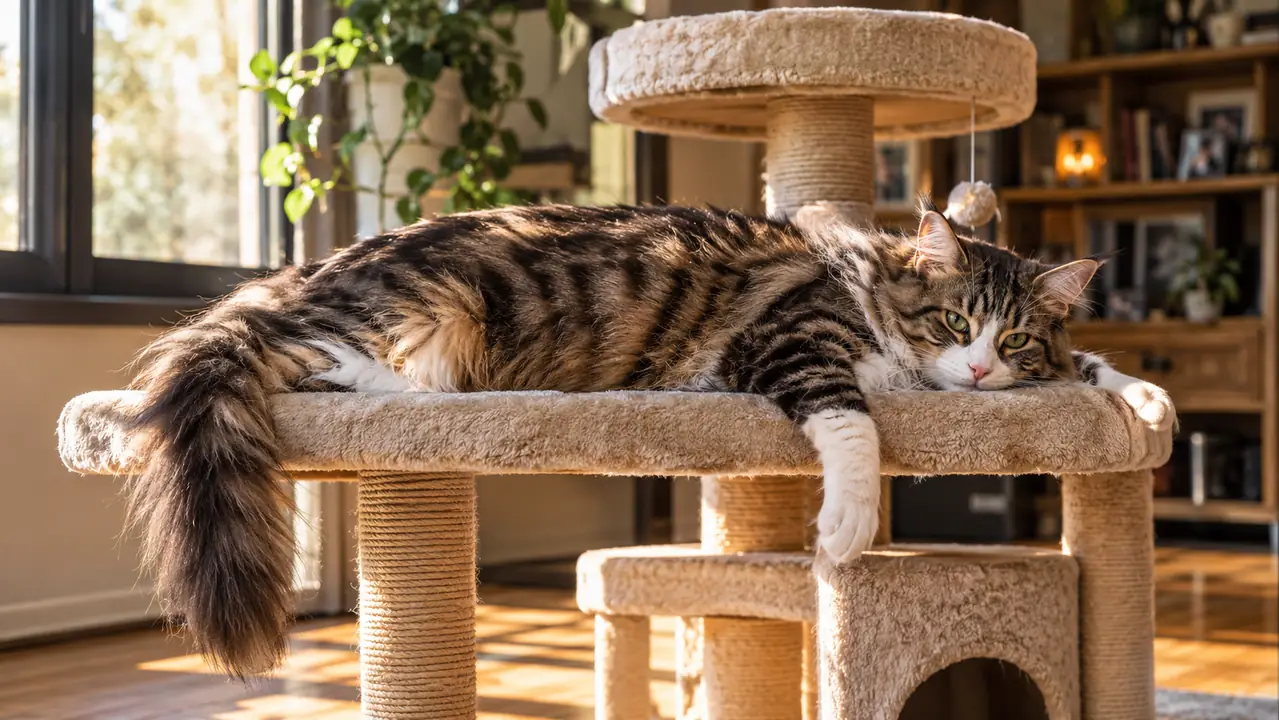
Biscuit is nine, about fourteen pounds, and a lap cat who is not interested in climbing for its own sake. He uses the wide pentagonal platform, which the listing puts at 17.7 by 21.7 inches. That is the piece that made this tree worth having. He can walk onto it, turn around, and lie flat with room on all sides, and it sits low enough that he is not doing a big jump to get there. He naps in the condo some afternoons.
The two of them share the middle levels without much drama, which was not a given. June goes up the sisal posts. Biscuit goes platform to platform. The pom-poms get batted in the evening. What they ignore: the sisal rope toys on the lower section have had almost no attention, and the scratching board is used mostly by Biscuit, in one long drag rather than a claw and pull. I would not buy this tree for the toys. I would buy it for the platforms and the posts.
What I Liked
- The footprint is 21.65 by 17.72 inches with the weight low, so it does not slide or tip when a cat launches off the top
- Five levels, including a 17.7 by 21.7 inch pentagonal platform wide enough for a fourteen pound cat to lie flat on
- 7 sisal scratching posts and 1 scratching board, and the sisal has not unwound in eight months
- Assembled in about an hour and a half with two people, and all the hardware was in the box
Where It Falls Short
- The top square perch is small, so a big cat will never use it
- No anti-tip strap is included. We bought one separately and screwed it into a stud
- The faux fur flattens where a cat lies every day. Cosmetic, but you see it
- At 64.17 inches and 35.49 pounds it needs a two-person carry and a wall you can reach with a stool
Eight months, two cats, one woodstove, and the tree has not moved. The strap we added was for Ray's peace of mind, not because the base asked for help.
Scratching Surfaces After Eight Months
The tree has seven sisal posts and one scratching board. What I have watched is that June uses two of the posts hard and ignores the other five, and the wear is on one side of those two, which is what you would expect from a cat that reaches up and pulls down in the same spot every time. The sisal on those two is frayed the way a well used post frays. It has not come unwound and it has not gone bald. The board gets a different kind of use, more of a horizontal drag, and it has held.
The other thing I have watched is the sofa. June had started on the arm of the front room sofa in February, and after this tree went up she stopped. I am not going to claim that will happen in your house, and I would not tell anyone this tree is a behavior fix. It happened in ours, and my honest read is that there was finally something in her own room that worked better than the sofa arm did.
This is the part where I would tell you to be honest with yourself about your own cat. If you have a cat that scratches one spot on one post, seven posts is more scratching surface than you need and you are paying for it in floor space. If you have a cat like June, who works a post from every angle, the multiple posts mean she moves around instead of destroying one. Either way, check the wear with your hand every few months. When sisal starts to go slick, that is when a post stops being interesting.
Who This Is For
This is for a household with at least one cat that climbs and at least one cat with some size to it, in a room with a wall you can reach and a floor you can put a wide base on. It suits a corner. It suits a house where the cats already spend their evenings in one room and you want the furniture in that room rather than spread across three. It also suits anyone who has been through a narrow tall tree that wobbled, because the difference here is in the base, and you can feel it the first time you bump into it.
It is a good fit if you are willing to spend an afternoon on assembly and a few dollars on an anti-tip strap from the hardware store. And it is a good fit if you want one tall piece rather than three short ones. It is not a behavior fix and it is not a health product. If your cat is older or heavier and you are worried about jumping, that is a conversation for your own vet, not for a product listing and not for me.
Who Should Skip It
Skip it if you have one small cat and no appetite for a 64 inch piece of furniture. A single cat will use maybe two of the five levels and you will be dusting the rest. Skip it if your walls are old plaster and you want a wall tie-off, because getting a strap into a stud through plaster is a job, and the base alone is what you would be relying on. Skip it if the cats' room is narrow, because 21.65 by 17.72 inches is real floor space.
I would also skip it if the top perch is the part you care about most. The square up top is a small cat's perch. If your cat is fourteen pounds, the pentagonal platform is where they will live, and if that is all you need, a shorter tree with one wide platform would do the same job with less height and less to dust.
Eight months in a room with two cats and a woodstove, and it has not moved an inch
Five levels, 64.17 inches tall, 7 sisal scratching posts and 1 scratching board. Measure your corner first, then check the current dimensions and stock on the Heybly product page.
Amazon Check Today's Price on Amazon →