
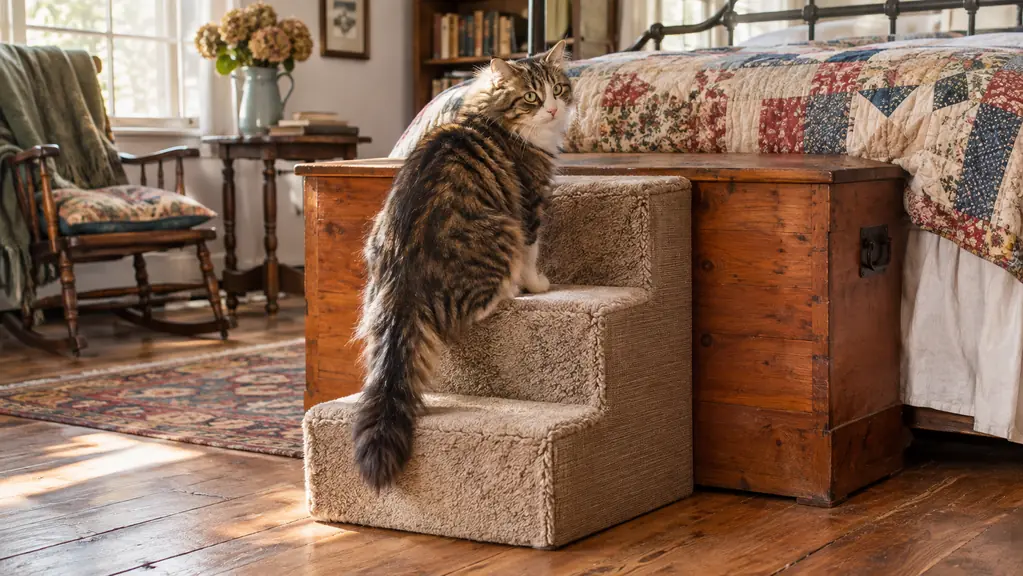
In July I stood in the upstairs hallway at eleven at night and watched Biscuit do the arithmetic. Front paws up on the cedar chest at the foot of our bed, back end still on the floor, ears forward. He used to make that jump without a second thought. That night he sat back down and looked at me.
Biscuit is nine, an orange tabby, and about fourteen pounds. At his summer checkup our vet said he was a little stiff for his age, that nothing was diagnosed, and that making the climb onto the bed easier was a reasonable idea. I am not a vet and I do not pretend to be one, so I will not sit here and tell you what your cat needs. What I can tell you is what we bought. In August we set the Aechonow 3-in-1 Pet Stairs against that cedar chest, and I have watched two very different cats use them every day since. This is the long version of what I found, including the parts that annoyed me.
One more thing before the details. June is three, eight pounds, and approximately half squirrel. She does not need stairs. She needs a ceiling.
The Quick Verdict
A short, heavy-footprint set of stairs with a real closed cubby underneath. Biscuit climbs it every night, June claims the cave, and the only thing I would change is how fixed the top step is once it is built.
Amazon Check Today's Price →Three steps that ended the eleven o'clock hesitation
The Aechonow stairs stand 18.9 inches tall on a 19.2 by 11.8 inch baseplate, with a covered cubby in the base and short scratching posts built into the sides. The idea is a shorter climb and something to dig into on the way past.
Amazon Check Today's Price on Amazon →How I've Used It
The stairs sit against the cedar chest at the foot of our bed, on the wood floor of the upstairs hall in the old part of the house. They are 18.9 inches tall and 19.3 inches long, and the top step lands roughly flush with the chest lid, which is the entire reason they work. Biscuit walks up three steps, steps onto the chest, and from there walks onto the quilt. There is no jump left anywhere in that sequence. Ray and I measured the chest before we ordered anything, because a set of stairs that comes up short turns into a launch pad and a set that comes up high turns into a wall.
We did look at a ramp first. A ramp is a long shallow triangle and it needs a run of floor to work, and in our hall the run of floor is where Ray leaves his boots. What sold me on stairs was the footprint. Nineteen and a bit inches against the wall is nothing at all. A ramp that lifts a cat from the floor to bed height at a pitch a stiff cat will actually walk is considerably longer than that, and I did not have the floor to give away.
A note on floors, because this house has two kinds. The old part is original wide plank wood, waxed. The back addition has laminate over a subfloor. We tried the stairs in both spots before settling on the hall, and the behavior was the same in each: a hard base on a smooth floor will skate a little on the first shove and then settle. Nothing about the stairs themselves changed between the two rooms.
June's relationship with them is different and worth saying plainly. She does not climb them to get on the bed. She is on the bed before I am. She uses the cubby underneath, and she uses the scratching posts on her way past, and twice now she has launched off the second step at something only she could see. Three months of that and the stairs are still square against the chest.
What Went Together, and What I Had to Think About
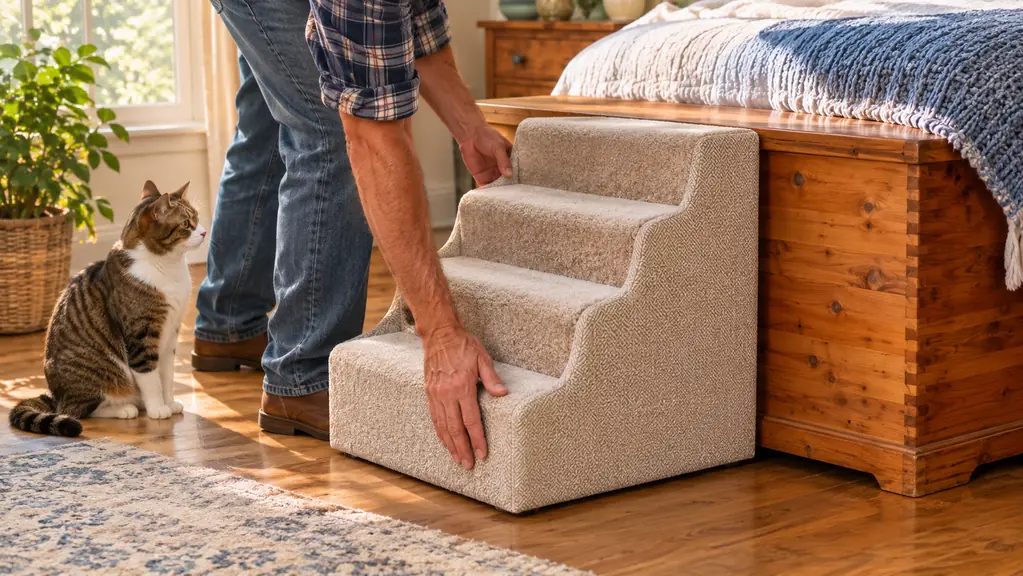
The listing says the included component is the instruction manual, so there was not much in the box besides the panels, the posts and the paperwork. Ray had it standing in about twenty minutes on a Sunday, and most of that was the two of us disagreeing about which panel was the front. If you have ever assembled anything out of a flat box you know the drill. The manual is brief. The pieces only go together one way, which is the good kind of brief, and once the baseplate is on you can feel that it is one rigid thing rather than four boards leaning on each other.
What I actually had to think about was placement, not assembly. On a waxed floor in an old house, everything slides. I set the stairs down, gave them a shove with my foot, and they skated maybe an inch before the base caught. So I put a thin rubber pad under the front edge and they have not moved since. That is not a defect in the product. It is what happens when you put a hard base on a waxed floor, and it is the kind of thing you notice in the first five minutes and then never think about again.
The other thing I did was check them against the chest every few days for the first week, because Biscuit comes at the top step from the left side of the hall rather than straight on. Three months of that has not shifted them, mostly because the cubby underneath acts as the tie between the two sides at floor level. Ray calls it a box girder. He is not wrong.
Does It Stay Put?
This is the question I actually had, because a set of stairs that rocks is worse than no stairs at all. A fourteen pound cat coming down three steps puts more sideways load on a base than you would guess. The Aechonow stairs are listed at 11.16 pounds, which is heavy for something this short, and the weight sits down in the baseplate rather than up in the steps. When Biscuit comes down in the morning, and he comes down fast, there is a small knock and that is all. No walk, no tip, no wobble I can feel through the floor.
The one thing I would flag is the distance from the top step to whatever you are bridging. Ours lands on the cedar chest, which is a nice wide landing with room to turn around. If your bed is tall and you plan to put these straight against the frame, measure first, because the top step is fixed at three levels and you cannot add a fourth. That is the honest limitation of a set this height. It is 18.9 inches tall and it will not become taller.
The Cave, the Scratching Posts, and Who Sleeps Where
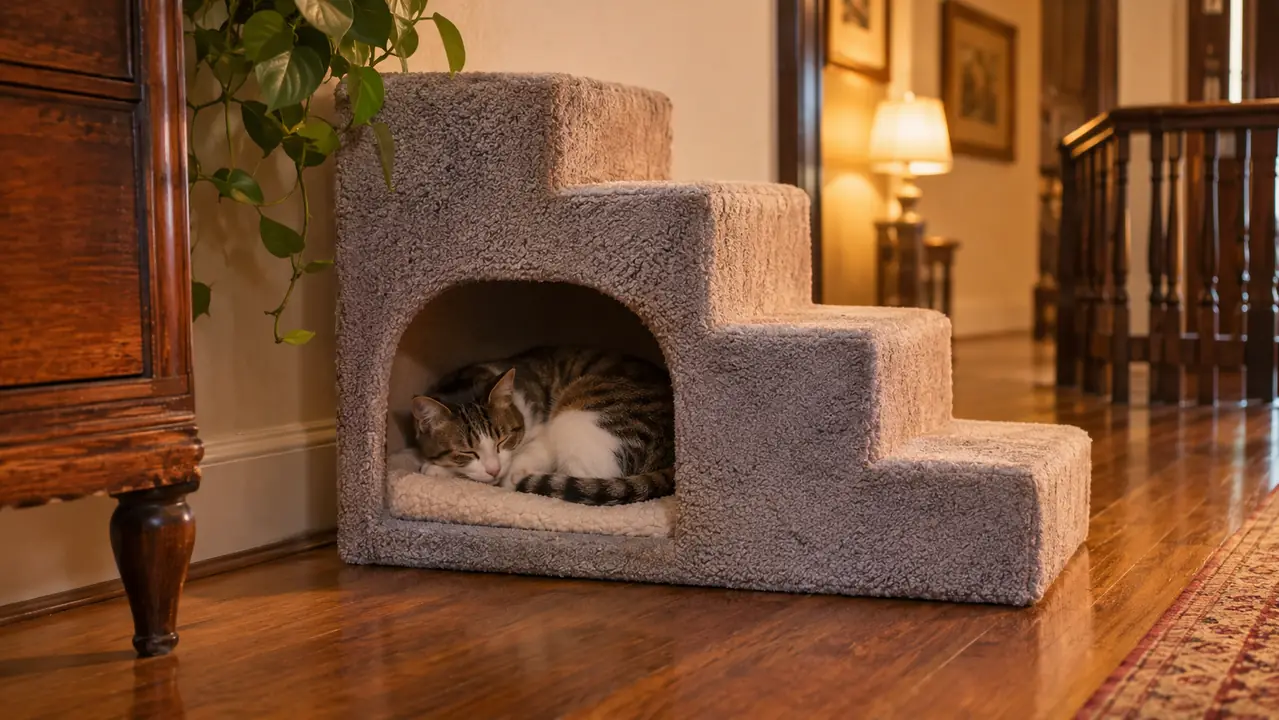
The cubby measures 12.9 by 10.8 inches in the listing and it is a genuinely closed box, not a shelf with a skirt around it. June, at eight pounds, turns around in there without touching the walls and sleeps in it most afternoons now that the weather has turned. Biscuit at fourteen pounds can get in and does get in, but he does not curl up the way she does. He fits. He does not lounge. If you have a big cat, that is worth knowing before you order, because the cave is the second best thing about this set and it is sized for the smaller animal in our house.
The scratching posts are listed at six to seven inches high. That sounds small, and it is, on purpose. It is the height a cat can stand up on and pull down through without overreaching. June uses the one on the lowest step every single time she walks past, which I did not expect. The scratching post she is supposed to use lives at the end of the sofa in the front room. This one is a bonus, and the bonus is the one that gets used.
Biscuit, for his part, has never scratched them once. He walks up, he steps onto the chest, he gets on the bed. He is a cat of firm habits and stairs are for going up, not for digging into. That is fine. One of the two pays for the feature.
Three Months In
As of November the stairs are in the same spot and the only visible wear is a little flattening of the tread surface where Biscuit lands on the top step. No loose posts, no split panel, no fraying at the corners of the cubby. The listing carries a two year manufacturer warranty. I have not had to test it, which is the only kind of warranty comment worth anything at three months.
Cleaning is a vacuum and a damp cloth. The cubby, being closed on most sides, collects a certain amount of orange fur, and I get in there with the upholstery attachment once a week or it gets ahead of me. There is no cover to pull off and put through the washer, which is the one thing the windowsill perch in the dining room has over it. Small trade for a solid box that does not collapse when a cat lands on it.
What I cannot tell you yet is how the joints look after a year, because I have only had these for three months and I am not going to guess. What I can tell you is that nothing has loosened in a season of daily use, that I have not had to re-tighten anything, and that the stairs have not wandered from where I put them.
Would I buy them again? Yes, and I would do it in July instead of August. The hesitation I watched that night was Biscuit telling me something and I spent a few weeks deciding whether I was imagining it. The stairs did not fix anything. He is nine and he is stiff and he will go on being both, and I would say the same to anyone who asks me whether stairs will solve a problem. What they did was take a jump out of his evening. In this house that was worth the floor space.
What I Liked
- Top step lands at chest height, so a nine year old cat walks to the bed instead of jumping to it
- 11.16 pounds with the mass in the baseplate; it does not walk or rock when a fourteen pound cat comes down fast
- The cubby is a real closed box and a small cat will sleep in it most days
- Short scratching posts built in at the height a cat actually pulls down through
- Small footprint at 19.3 by 11.8 inches on the floor
- Three months of daily use with no loose posts, split panels or re-tightening
Where It Falls Short
- Fixed at three levels, so a bed much above 19 inches leaves a gap you cannot close
- Hard base skates on a waxed wood floor until you put a pad under the front edge
- Cave is 12.9 by 10.8 inches, sized for a small to average cat rather than a large one
- Treads are not removable, so fur comes out with a vacuum and not a washing machine
- The manual is brief and the front panel is easy to put on backwards
Three months of a fourteen pound cat coming down those steps at speed, and they have not walked an inch. That is the whole test.
Who This Is For
These are for a household with an older or heavier cat that has started to think twice about a jump onto a bed or a sofa, where the surface you are bridging sits at roughly the height these land at. They suit a house with a second, younger cat too, because the cubby means the smaller animal gets something out of the purchase. If your floor space is tight and one of your cats likes a closed box, this earns its corner. In our house it stopped being a mobility purchase and became furniture inside a week, which is the highest compliment I can pay a piece of cat gear.
Who Should Skip It
Skip these if your bed is tall. Nineteen inches is nineteen inches and there is no fourth step, so a thick mattress on a high frame is going to leave a gap. Skip them if your cat is large and likes to sleep curled in a covered space, because the cave is sized for the smaller animal. And skip them if you want something you can fold up and put in a closet at the end of the day. These are floor mounted, eleven pounds, and they live wherever you set them down. If any of that is a problem, a ramp is a different shape of answer, and it is worth reading the comparison before you decide which shape your room can take. One last thing, and I mean it: if your cat is stiff, sore or has changed how it moves, that is a conversation with your own vet, not with me and not with a listing page.
If your cat has started doing the arithmetic before a jump
Three carpeted steps, a closed cubby underneath, short scratching posts and a baseplate that stays where you put it. Measure the height you are bridging first, then measure it again, and the Aechonow stairs will do the rest of the work.
Amazon Check Today's Price on Amazon →