
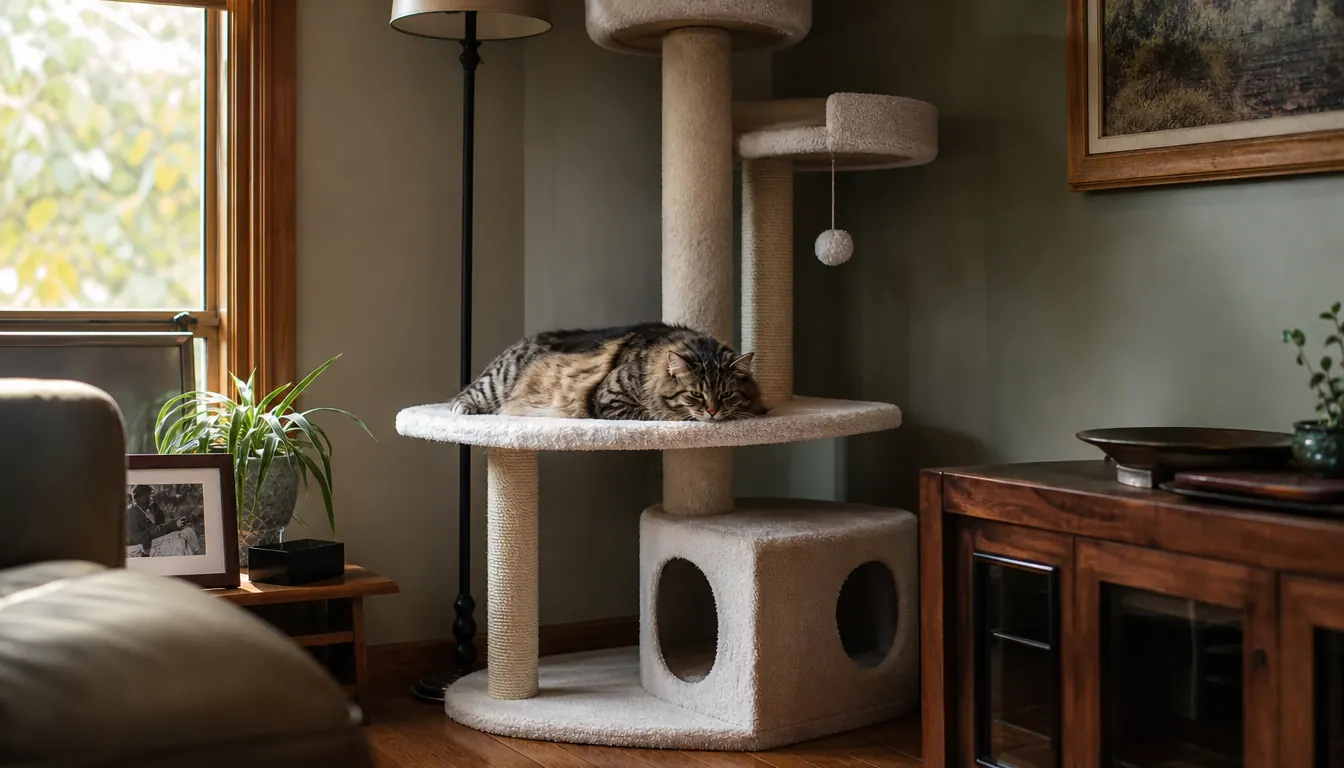
Two cats, one tall piece of furniture, and completely opposite ideas about what it is for. Biscuit is our orange tabby, nine years old and about fourteen pounds, and he has started taking the stairs a little slower than he used to. June is three, gray and white, eight pounds, and she climbs anything that will hold still. A tree that only serves one of them is a waste of a good corner.
We bought the Heybly Heavy-Duty Cat Tree for Large Cats in March, the five level tower with the wide base, and put it in the corner of the den in the back addition near the woodstove. Ray and I assembled it on a Saturday afternoon in about an hour and a half. I read the sheet, he drilled, and I did the leveling, which is the division of labor around here and probably the reason nothing has fallen down yet. What I learned is that the assembly is not the hard part. Placement and anchoring are.
One tower, two cats, and a base that does not walk across the floor
The Heybly five level tree has seven sisal posts, a scratching board, a condo and two top perches at different heights. It is the one standing in our den right now.
Amazon Check Today's Price on Amazon →Step 1: Pick the corner before you open the box
The listing gives the footprint as 21.65 by 17.72 inches and the height as 64.17 inches. Those three numbers decide where it goes. I measured the den corner with a tape, then measured the ceiling height, because a 64 inch tree under a low soffit is a tree you end up moving. Measure the patch of floor, not the wall, and leave yourself room to walk around two sides of it.
Two things I check now that I did not check with the first tall piece of cat furniture we bought. First, the floor. Our house is old and nothing in it is level, so I lay a torpedo level on the floor where the base will sit and look at the bubble. Second, the wall behind it. Ray runs a stud finder along that spot before anything gets built, because the anchor goes into a stud, and you want to know where that stud is before the tree is standing in front of it blocking your view.
Materials matter here. The den in the back addition has drywall. The old part of the house has plaster over lath, and I do not hang anything heavy on plaster if I can help it. That one consideration moved our tree into the back room, which turned out to be the right room anyway because it is where we both sit in the evening and where the woodstove keeps the floor warm.
Step 2: Sort the hardware before you tighten anything
The box is 35.49 pounds, so it is a two person carry and it is not something to drag up a staircase by yourself. We opened it on the den floor and laid the panels out by size so I could see what was what before I started reading the steps in order. The frame is engineered wood with faux fur and sisal on it, and the panels are labeled well enough that matching them to the sheet took a couple of minutes.
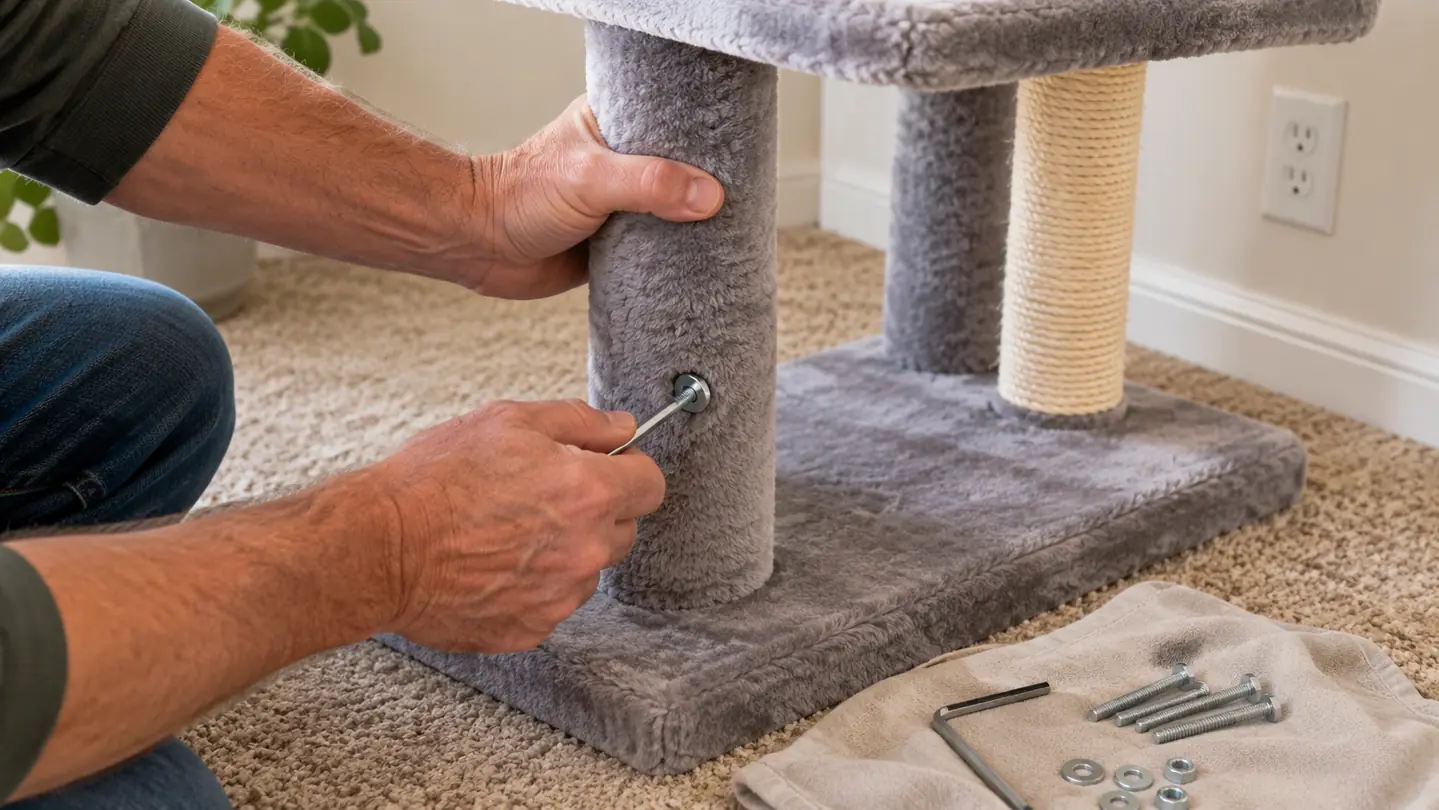
I count the hardware against the sheet before assembly starts. Every time I have skipped that step I have gotten to the last section and come up one bolt short, and then the whole thing sits half finished while somebody drives to the hardware store. Lay the screws out on a plate in the order you will use them and keep the hex key from the box taped to the sheet so it does not wander off.
One habit worth having: snug the bolts, do not crank them. On a frame built from engineered wood panels, everything goes together easier if it can still move a little while you are squaring it up. The final tightening pass comes at the end, once the whole thing is standing and you have checked it with a level. Ray tightens by feel and I check behind him with the level, and that combination has worked on every piece of furniture in this house.
Step 3: Build from the base up and get the low levels right
The base goes down first, and it is the piece that decides whether the whole tower feels solid. The Heybly has a widened frame and the base is broad relative to the height, which is the main reason I chose this tower over a narrower one. Set it exactly where you measured, not two inches off, because moving a 64 inch tree after it is built is a two person job and the cats will be underfoot the whole time.
The lower levels matter more than the product photos suggest. Biscuit is fourteen pounds and he does not want to climb in order to get comfortable. The big lower platform is where he lands, and the condo is where he naps some afternoons with one paw hanging out the opening. When you stack the platforms, check that each one sits level front to back and not just left to right. A platform that tips forward is one a heavy cat will step onto once and then avoid.
Step 4: Finish the top, then test it before the toys go on
The top two levels are the two shapes named in the listing: a square perch for looking around and a pentagonal platform that measures 17.7 by 21.7 inches. That pentagonal one is the best feature of this tree for a cat that wants to lie flat and still be high up. It is a real difference from the narrow round perches on most towers, and it is the reason a fourteen pound cat can use the upper half of a tall tree at all, if he decides he wants to.
There are seven sisal posts and one scratching board on this tree. That sounds like a lot until you live with a cat who scratches every day. June works three of them regularly and ignores the rest. The posts on the side she favors are showing wear already, which is exactly what they are there for, and it is the reason I would rather have more posts than fewer on a tree this tall.
Before the pom-poms and the sisal rope toy go on, push the top section gently with one hand. There should be a small amount of give and no creak. If it rocks, find the bolt that is still loose or the spot where the floor is not level, and fix that first. Then do the final tightening pass from the base upward and check the level one more time, because a tower that is square when it is empty can shift once it has been climbed.
Step 5: Anchor it, then arrange it for two different cats
The tree is floor mounted, and that is fine for a cat that walks onto it. It is not enough for a cat that launches. Ray screwed a plain furniture anti-tip strap, bought separately at the hardware store, from the top section into a wall stud. That strap is not part of the product and it does not come in the box. I would still do it, and I would do it before the cats get a vote, because once the tree is claimed you are not going to want to take it apart again.
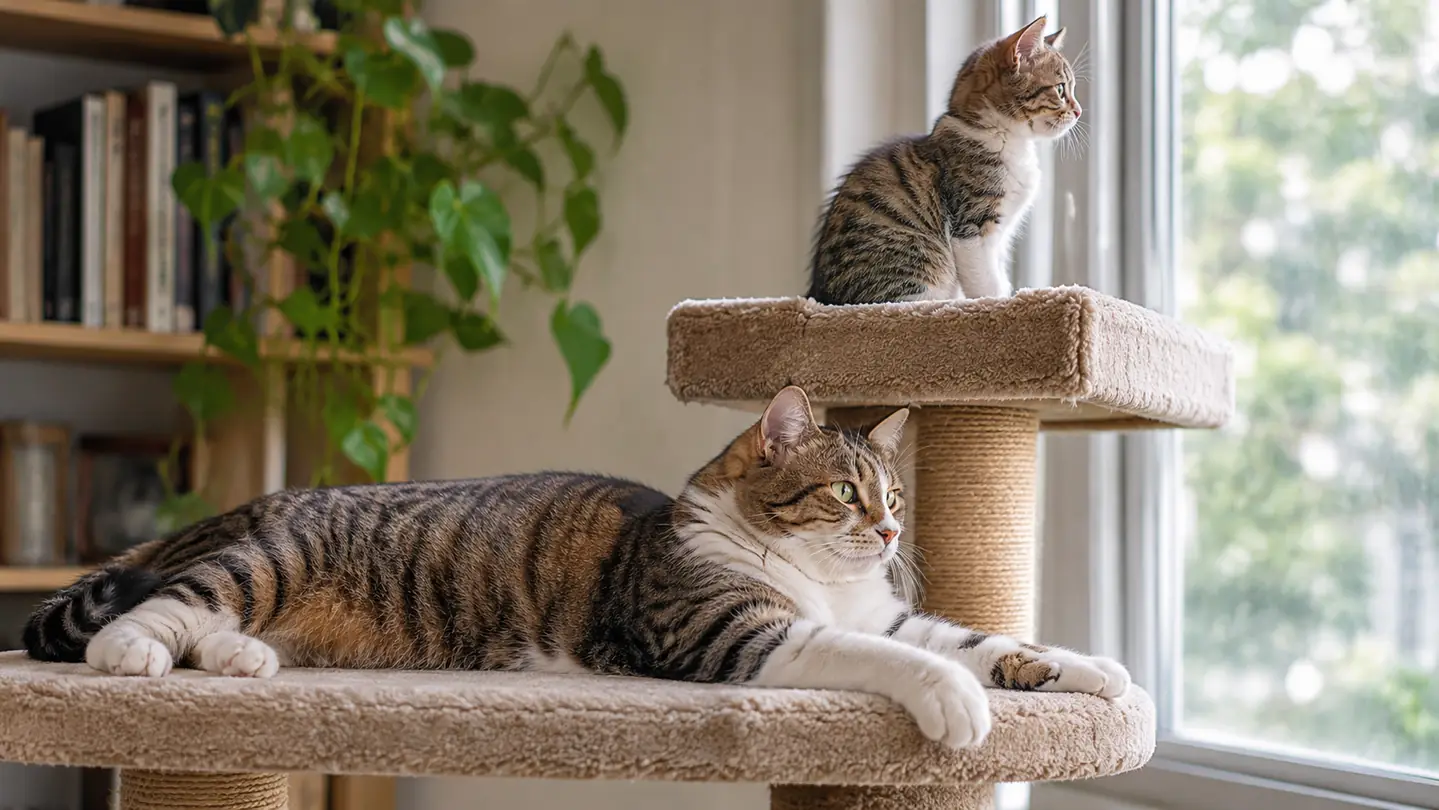
Once it is anchored, arrange the tree around the two animals you actually have rather than the cat you imagined. June claimed the square top perch the first evening and has not given it up. Biscuit never goes above the third level, and he has never needed to. If I had tried to make them share the top, I would have ended up with one displaced cat, one anxious cat and a tree that only half got used.
Two small adjustments made a difference. I turned the tower so the posts June scratches most are on the open side rather than against the wall, which is a detail I got wrong on the first attempt and had to redo. And I left the lowest platform clear of the toys so Biscuit has a clean landing with nothing dangling in his face. The pom-poms and the rope toy hang where June can bat at them from the perch above, which is the only place she wants to be anyway.
June claimed the square top perch the first evening and has not given it up. Biscuit never goes above the third level, and he has never needed to.
What Else Helps
A tall tree is one part of a setup, not the whole thing. In our house five pieces do different jobs and the two cats use them in different ways. The SmartCat scratching post stands at the end of the sofa in the front living room, and June scratches it daily while Biscuit uses it for a long stretch in the morning. The Zakkart windowsill perch hooks into the slot along the dining room sill with no drilling and no suction cups, and Biscuit spends most mornings there watching the bird feeder, with June using it whenever he is not.
The FUKUMARU wall shelves are on the long drywall wall of the den, mounted into studs on 16 inch centers. They are on a different wall from the tree with no jump route between them, which was deliberate. June runs the bridge and sleeps in the wall bed. Biscuit does not use them at all, and since the listing names small and medium cats, I have never tried to put him on them. Not every piece has to serve every cat, and expecting it to is how people end up disappointed in perfectly good furniture.
The Aechonow stairs at the foot of our bed are there because Biscuit had started hesitating before jumping up onto the bed over the summer. At his checkup our vet said he was a little stiff for his age, nothing diagnosed, and that making the climb easier was reasonable. He walks up every night now. I am not a vet and I am not going to tell you what your cat needs, so ask yours. What I can tell you is that an easier route up is a simple thing to provide, and the stairs and the low platform on the tree do that same job in two different rooms.
If your two cats want two different things, give them two different heights
The Heybly five level tree has seven sisal posts, a scratching board, a square top perch and a 17.7 by 21.7 inch pentagonal platform. The lower levels handle the cat who would rather not climb at all.
Amazon Check Today's Price on Amazon →