
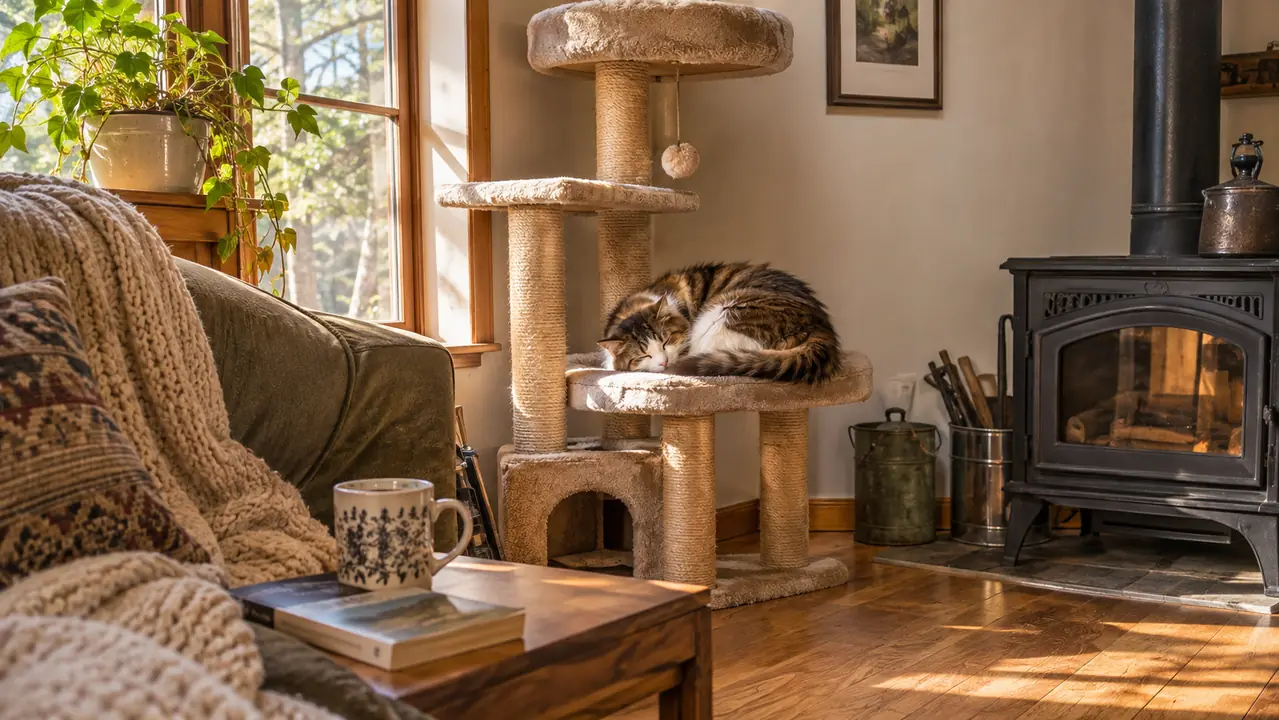
Short answer first. In our house, the Heybly Heavy-Duty Cat Tree is the one I would buy again for a big cat who wants to lie down somewhere high. A floor-to-ceiling cat tree is the better pick in one narrower situation: a single agile climber, a small room, and a flat solid ceiling at a height the pole can actually span. We have both kinds of cat and only one of the trees, so I have thought about this more than a person probably should.
The two cats are the reason. Biscuit is a nine-year-old orange tabby, about fourteen pounds, and his idea of a good afternoon is lying flat on something wide. June is three, eight pounds, and goes up anything tall. We bought the Heybly in March 2026 and assembled it on a Saturday afternoon in the corner of the den in our back addition, near the woodstove. Before that we spent a couple of weeks reading listings for floor-to-ceiling trees, measuring ceilings, and arguing about whether we wanted a pole standing in the middle of a room. That measuring turned out to be most of the decision.
| Heybly Heavy-Duty Cat Tree | Floor-to-Ceiling Cat Tree | |
|---|---|---|
| Floor space used | A permanent 21.65 by 17.72 inch footprint | One base plate and a pole, almost no floor taken |
| How it stays up | Stands on its own wide base. We added a strap into a stud | Wedges between floor and ceiling on tension, no wall fixing |
| Steady under a heavy landing | 35.49 pound frame on a widened base, has not moved in eight months | Depends entirely on the ceiling surface and how tight it is set |
| Top level | A square perch for looking around plus a 17.7 by 21.7 inch pentagonal platform | Usually a single round platform at the top of the pole |
| Room to lie flat | The pentagonal platform takes a big cat stretched out | Perches tend to be sized for sitting, not sprawling |
| Scratching surface | Seven sisal posts and one scratching board | Sisal wrapped around the pole itself |
| Enclosed space | Includes a condo | Open platforms, no enclosed cubby in most designs |
| Setup time | About an hour and a half with two people | Minutes, provided the ceiling height is right |
| Moving it to another room | Unhook the strap, carry it, re-level it | Loosen, move, tighten again |
| Sloped, beamed or very high ceilings | Does not care what the ceiling is doing | Needs a flat solid surface within the pole range |
| Best for | A big cat who lies down, or two cats sharing | One agile climber in tight quarters |
How We Ended Up Comparing These Two
We looked at floor-to-ceiling trees first. Our old house has a narrow front room and a hallway that is really just a passage, and a pole that runs all the way up sounds like it takes no floor at all. That is the pitch, and it is mostly true. What the listings do not prepare you for is how much the ceiling matters. The original part of this house has plaster walls and a ceiling that is not level anywhere. Ray put a straightedge against it and laughed out loud. The back addition, where the den is, has drywall and a ceiling we could actually measure without guessing.
So we measured, on a cold Saturday in February with a tape measure and Ray up the stepladder. Nine feet in the den, eight in the front room, and one spot near the stairs where the ceiling slopes down toward the landing. A tension tree has to sit under a flat, solid surface at a height the pole can span, and every listing we read asked for a firm ceiling inside a stated range, with a note about how much adjustment the pole itself allows. The den came in near the top of one range and outside another. The front room sat below the bottom of both. That quietly ruled out the two rooms where we most wanted a tree, and it ruled them out on a measurement rather than on a preference, which is a good deal easier to argue with at the kitchen table. We bought the Heybly instead, and I still read the height range on floor-to-ceiling listings out of habit, because June would use one and I have not fully talked myself out of it.
Assembly took about an hour and a half on a Saturday in March, with the box open in the hallway and the parts laid out in rows the way the sheet suggested. Ray drilled and I read the diagram and held the level, and we got one side of the top section on upside down and had to back it out, which cost us ten minutes and a certain amount of dignity. The frame is engineered wood with faux fur over it and sisal on the posts, and the base is genuinely wide. It sits in the corner of the den near the woodstove, which is the warmest spot in the house and therefore the most contested real estate we own. Ray also screwed a plain furniture anti-tip strap from the top section into a wall stud. The strap is not part of the product and it is not in the box. We bought it separately at the hardware store and I would not skip it with a fourteen pound cat who lands hard.
Where the Heybly Wins
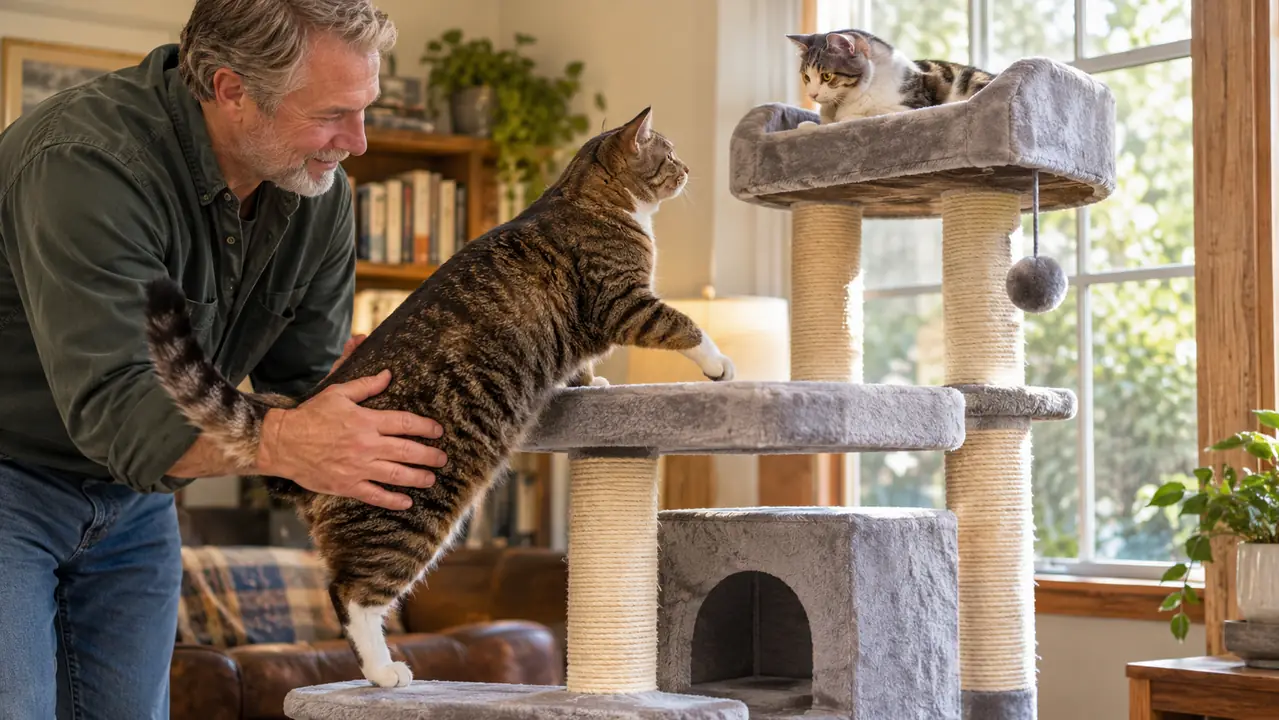
Numbers first, because they are most of the argument. The base is 21.65 by 17.72 inches and the whole thing weighs 35.49 pounds across five levels, up to about 64 inches tall. That is a lot of weight sitting low, and weight sitting low is the entire trick with a tree a big cat uses. Biscuit is fourteen pounds and he arrives on a platform like a dropped suitcase. He does not so much jump down as step off and let gravity finish the argument, and the frame takes it without a sound. One evening in April, June went off the square perch at a dead run after a moth and landed most of the way across the rug. The tree rocked perhaps a quarter of an inch and settled. In eight months it has not walked, tipped, or shifted against the wall, and I check it about once a week out of habit, one hand on the top section, pushing.
The platform sizes are what sold me. The listing describes two top levels: a square perch for looking out over the room, and a pentagonal platform at 17.7 by 21.7 inches. That pentagon is where Biscuit lives now. He can stretch out flat on it, which is the only thing he has ever wanted from furniture, and most tall trees I looked at finish with perches sized for a cat who sits. June takes the square perch on top and surveys the den from it. The two of them sorted that arrangement out in about three days without any help from us.
Scratching is the other place the design earns its keep. Seven sisal posts and one scratching board, according to the listing. June scratches everything she passes, so having that many surfaces in one place means she works the tree instead of the arm of the sofa. The sisal on the post she favors is already showing wear on one side. That is honest wear and it tells me she is using it, which is more than I can say for half the things I have bought for these cats.
June claimed the square perch on top the first evening and has not given it up. Biscuit never even tried for it. He took the big pentagonal platform below and has slept there most afternoons since March.
Where a Floor-to-Ceiling Cat Tree Wins
Here is the honest side of it. A floor-to-ceiling tree takes almost no floor. One base plate, one pole, straight up to the ceiling. In a small apartment, or a room where every square foot is already spoken for, that is a real advantage and I am not going to pretend otherwise. Our 21.65 by 17.72 inch base is a corner of the den we will never get back.
It also needs no wall fixing. A properly set tension pole wedges between the floor and the ceiling and stays put, so no drilling, no strap, no stud finder, no conversation with a landlord. For a renter with plain drywall overhead, that matters more than anything I have said about platform sizes. It goes up in minutes and comes down in minutes, and it moves house with you. I read through a long run of reviews on two of them while we were deciding, and the complaints clustered in one place: a ceiling that turned out to be textured, a drop panel, a beam where the pole needed to sit, or a pole that arrived a shade short for the room. Not the design. The ceiling. And for a climber like June, all that extra height is height she would actually use, which is the part that keeps me reading listings.
If your cat is the lie-down kind, this is the corner we would furnish again
A wide base, a 35.49 pound frame and a pentagonal platform at 17.7 by 21.7 inches, which is enough room for a big cat to stretch out flat. That is the whole reason it is still in our den eight months on.
Amazon Check today's price on Amazon →
Setup, Ceilings, and the Anti-Tip Strap
If you are leaning toward a pole tree, do the measuring before you order anything. Height from floor to ceiling at the exact spot where it will stand, then look up and check what is up there: texture, beams, a drop panel, a slope, a light fixture in the way. Every listing gives a height range the pole adjusts inside. Get that wrong and you are either returning a tall box or shimming the base, and shimming a tension pole with a cat watching is not a job I would wish on anyone.
If you are leaning toward the Heybly, plan for two things. First, two people for assembly. Not because it is difficult, but because holding a level and reading a diagram at the same time takes four hands and some patience. Second, budget for a furniture anti-tip strap. Ours came from the hardware store and Ray had it fitted into a stud in about ten minutes. The tree stands perfectly well on its own. The strap is for the evening a big cat launches off the top perch at an angle, and I would rather have it and never need it.
One more note on walls, because this caught us out. The original part of our house is plaster over lath, and a strap into that is a different job than a strap into drywall. Plaster is brittle and it crumbles around a screw, which I know because a shelf bracket in the front room did exactly that two winters ago and took a serving dish with it on the way down. We put the tree in the back addition where the walls are drywall and the studs sit on sixteen inch centers, and Ray found one with the stud finder before he drilled a single hole, then marked it in pencil so neither of us lost the spot while holding the strap and the level at the same time. If your walls are old, find the stud first or use an anchor rated for the load, and if you are not certain which you have, ask someone who hangs heavy things for a living.
What I Liked
- Wide base and a 35.49 pound frame that has not shifted once in eight months
- Seven sisal posts and a scratching board, so a cat who scratches everything has options
- A square top perch plus a pentagonal platform at 17.7 by 21.7 inches that a big cat can lie flat on
- Includes a condo for the afternoons a cat wants to be hidden
- Does not depend on your ceiling being flat, level or at any particular height
Where It Falls Short
- Takes a permanent 21.65 by 17.72 inches of floor in whichever room you choose
- About an hour and a half to assemble, and it wants two people
- No anti-tip strap in the box. We bought one separately and I would not skip it
- The sisal on one post is already showing wear on the side June works hardest
- Biscuit ignored the top levels entirely, so a third of the height is June's alone
Who Should Buy Which
Take the Heybly if your household has a big cat who lies down, or two cats who need to share, or a corner you are willing to give over permanently. The wide base, the pentagonal platform, the condo and the amount of sisal make it a piece of furniture rather than a climbing toy. It suits Biscuit exactly. It also gives June enough to do that she has stopped working the sofa arm, which was the reason we went shopping in the first place.
Take a floor-to-ceiling tree if you have one agile cat, a small room, a flat solid ceiling at a workable height, and no appetite for drilling. June would be up that pole before I finished tightening it, and I say that with some affection. It is the right answer for a climber in tight quarters. It is the wrong answer for a fourteen pound cat who wants to sprawl, because the perches are generally sized for sitting, and it is the wrong answer under a ceiling you cannot trust. If you are not sure which cat you have, watch where they go when they are bored, then buy for that.
Built for the cat who lands hard, not just the one who climbs fast
Five levels, seven sisal posts, a condo and a platform wide enough to lie flat on. It has held a fourteen pound tabby and a three-year-old climber for eight months in our den without moving.
Amazon See the Heybly cat tree on Amazon →