
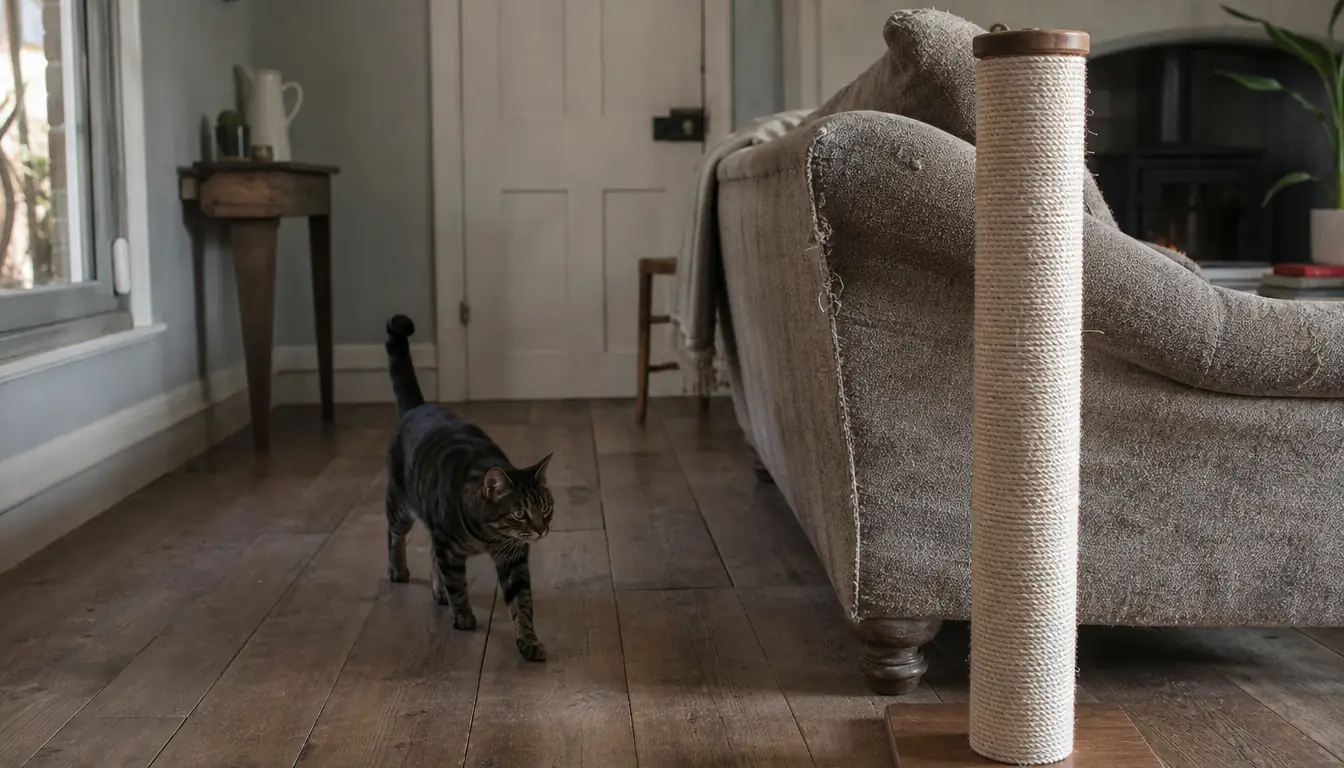
June had the arm of the sofa worn pale by February. Not shredded, just fuzzy and pale where she pulled herself up and dug in, and the old carpeted post in the corner of the front living room was scraped bare down to the backing. She had used that post for two years and then, somewhere around Christmas, she quit. I moved the old post two feet to the left and she found the sofa again by Thursday. The fix, when it came, turned out to be less about finding a better post than I expected and more about where the post sits and whether it moves when a cat leans on it.
We bought the SmartCat scratching post, the 32 inch one, in January 2026 and put it at the end of the sofa instead of in the corner. That was the whole change. June scratches it every day. Biscuit, who is nine and about fourteen pounds and takes the stairs a little slower than he used to, uses it for one long full length stretch every morning before he goes to his bowl. Within a few weeks June had quit going for the sofa arm. What follows is the order of operations I would hand to somebody in December, five steps, with the parts that turned out to matter.
Start with a post that stands 32 inches and doesn't rock
The SmartCat post is sisal fiber on a 16 by 16 inch base, 32 inches tall, and the listing says it goes together with two screws and two dowels. Ours has stood at the end of the sofa since January and has never tipped.
Amazon Check Today's Price on Amazon →Step 1: Put the post where the scratching already happens
The old post lived in the corner of the front living room, which is where a scratching post goes if you are arranging a room and not watching a cat. June used it for a while and then quit. When I finally paid attention, she was working the left arm of the sofa, the one she hauls herself up on before she gets to the cushion, and the trim on the hall doorway when she came around it at a run. Those were the two spots. Neither of them was the corner.
So put the post next to the thing that is being scratched, not across the room from it. Ours stands at the end of the sofa, which means June's front paws land on sisal a half second before they would have landed on upholstery. She does not have to choose between the two surfaces, because one is directly in front of the other. A post eight feet away is a suggestion. A post at the arm of the sofa is the path of least resistance, and cats are not sentimental about which path they take.
Measure before you order. The base on the SmartCat post is 16 by 16 inches, so it wants a real piece of floor, not a gap. I taped the space between the sofa and the wall before we bought anything, because a post that has to be squeezed in gets squeezed in at an angle and then it rocks, and a rocking post is a post your cat will not trust. Ours sits square with a few inches of clearance on the wall side. If your spot is tight, move the sofa two inches rather than buying a smaller post.
Step 2: Assemble it, then push on it the way a cat would
Ray had the SmartCat post out of the box and standing in a few minutes. The listing says two screws and two dowels and that is exactly what it is: no cams, no brackets, no bag of mystery hardware left over at the end. I read the assembly sheet anyway, because I always read the sheet, and nothing in it surprised me. If you have put together flat pack furniture in the last ten years, this is easier than nearly all of it. The one note on the listing is that care is hand wash only, which for a sisal post means you vacuum it rather than wiping it down.
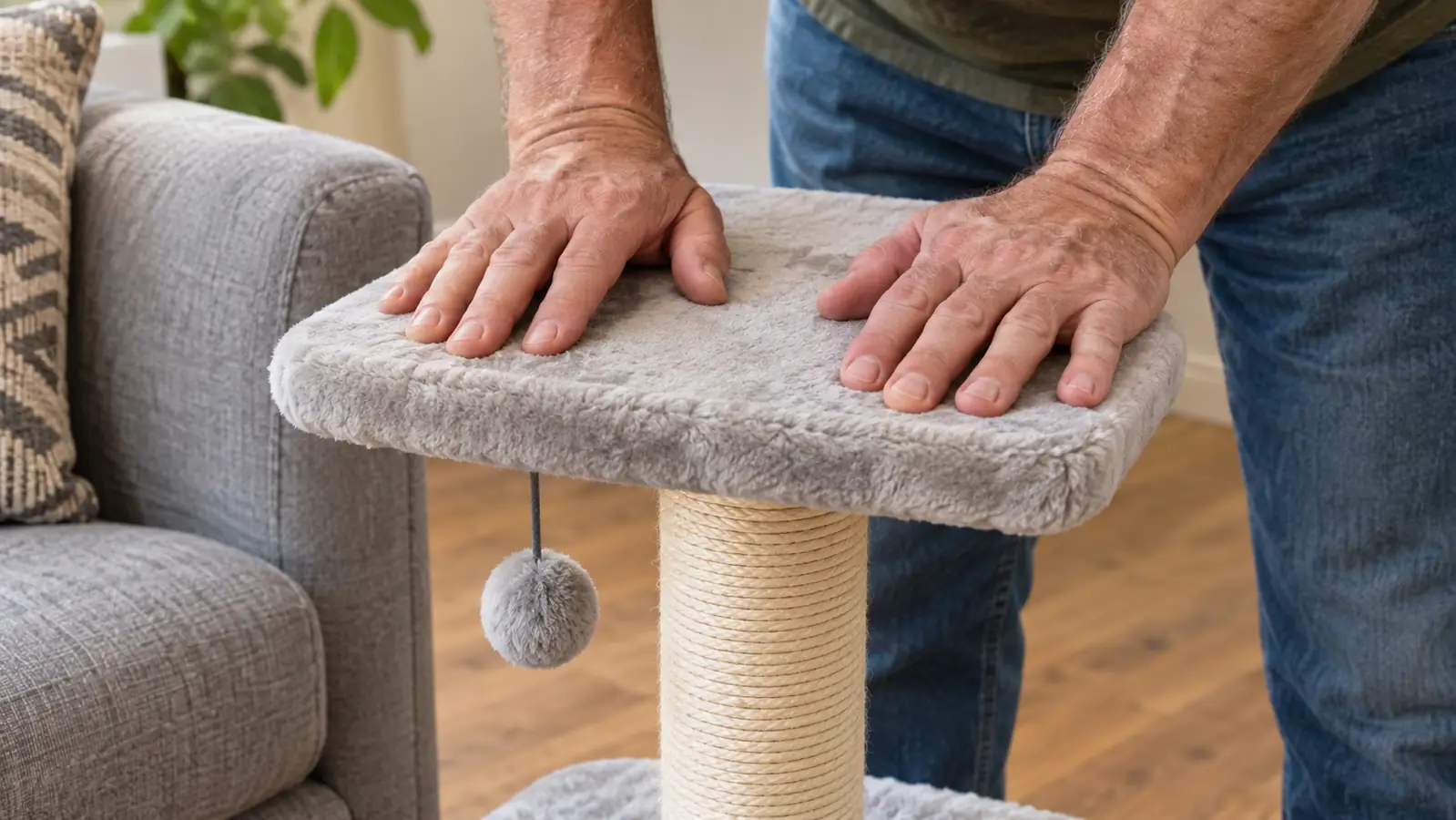
Then test it. Put the flat of your hand on the top of the post and push hard, the way a fourteen pound cat lands on it when he throws himself up. It should not rock and it should not skid. Ours sits on wood floor with the edge of a thin rug nearby and it has not moved. If yours rocks, the cause is almost always the floor: a seam, a rug edge, a warped old board. Slide it a foot and try again before your cat tries it for you, because a post that shifts under a cat once gets abandoned, and cats are not generous about second chances.
We did not fasten ours to anything. Ten months in, it has never tipped, and Biscuit is not a small animal. The base is 16 by 16 and the whole thing weighs 13 and a half pounds, so there is some heft sitting low. If you have a cat who launches off the top of a bookcase onto whatever is underneath, use your own judgment about that, but ours has taken a daily beating and stayed where we put it.
Step 3: Get the height right for a full stretch
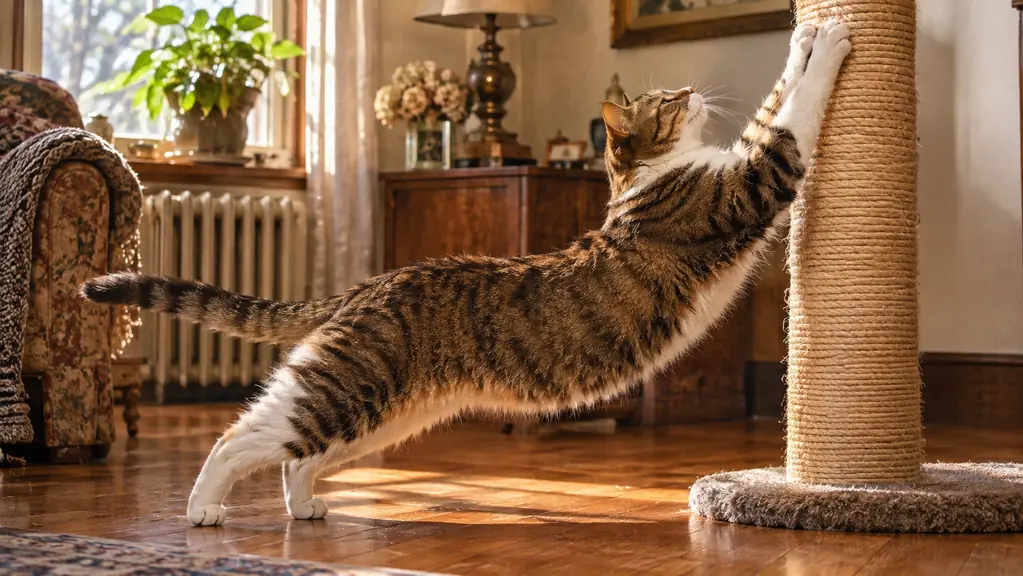
Scratching is not a small motion. A cat stands up, reaches both front paws overhead, and pulls down with the whole body while the back legs stay braced. If the post is shorter than the cat's reach, the stretch gets cut off halfway and the cat finishes the job on the arm of your sofa, which is conveniently tall. This is the thing the short cheap posts get wrong, and it is why a 32 inch post does a different job than an 18 inch one.
Our two are at opposite ends of the size range. June is three years old and about eight pounds, and she works the post in short hard bursts, up and down, several times a day. Biscuit is nine and about fourteen pounds, and he uses it once each morning for one long, slow, full length stretch. Same post, two completely different jobs, and both of them need the height. A short post would have suited June fine and left Biscuit hunched over with nowhere to put his front paws.
You can tell whether the height is working by watching, not by measuring your cat. If they start a stretch, get halfway up, and then drop off and walk away, the post is too short for them. If they reach the top and their paws keep going, it is about right. It also helps to look at where the claw marks land on the sisal after a few weeks. Marks in one narrow band, low down, usually mean a cat who is hitting the same spot over and over because there is nowhere further up to go.
The post did not fix June. Putting it ten feet from where the old one stood, at the end of the sofa, did.
Step 4: Redirect in the moment, not an hour later
The correction that worked here was boring and physical. When June went for the sofa arm, I picked her up, set her on the post, and walked away. No scolding, no spray bottle, no holding her paws against the sisal like I was teaching a child to write her letters. Cats do not connect a punishment to something they did ninety seconds ago, and a cat who gets startled off a scratching post learns to avoid the post, which is the opposite of what you are after.
You have to catch it in the act, which means the post needs to be somewhere you can see it from where you actually sit. That is another argument for the end of the front room sofa rather than a spare bedroom. I can redirect from the kitchen doorway. From the other end of the house with a door shut, I cannot, and a redirect you cannot deliver is not a plan, it is a wish.
It also has to be the same move from everyone in the house. Ray had a habit of tapping the sofa arm and saying no, which is a fine sentiment and accomplishes nothing. Two people doing two different things is worse than one person doing nothing, because the cat gets inconsistent information and the sofa still gets scratched. We agreed on one thing: pick up, set down on the post, walk away. It took about three weeks of that before June stopped testing the arm.
Step 5: Give it three weeks and change one thing at a time
June was on the post the first day. That is not a brag, it is luck: she was already a vertical scratcher who had lost her post to wear. Biscuit took longer, maybe two weeks, and he was never the problem in the first place, he was just cautious about anything new in the front room. If your cat walks past it for the first week, that is not a verdict. Move it a couple of feet, scratch the sisal with your fingernails so it makes a noise, and then leave the room. Curiosity does more work than encouragement.
The mistake I would steer you away from is the shopping mistake, which is buying a second post before the first one has had a fair trial in a fair location. If your cat is not using a 32 inch sisal post that stands where they already scratch and does not rock, the answer is usually a different spot or a different orientation, not a different post. Some cats want to scratch flat on the floor. No tall post will ever be the thing they wanted, and that is not a failure of the post.
Be honest about the timeline, too. Ten months on, June scratches the SmartCat post daily and the sofa arm has been left alone. That is one cat in one house, and I am not going to tell you it will work for yours, because I have met enough cats to know better. What I will tell you is that the variables you control are location, stability and height, in that order, and most of the posts gathering dust in garages failed on the first one.
What Else Helps
Keep the old worn post out for a while. June's old carpeted post was bare to the backing and I nearly carried it to the curb, and then I thought better of pulling a cat's only scratching option on the same day I introduced a new one. It stayed in the corner until the SmartCat post was clearly in daily use, and then it went out. A week of having both is cheaper than a month of redirecting a confused cat.
A second scratcher in a different room helps, and it does not have to be tall or fancy. A flat cardboard one in the hall near the doorway June rounds at a run would have saved me some walking. Cats like to scratch where they wake up and where they walk through, and one post in one room covers roughly one of those. Two covers most of them, and the second one can be the cheap one.
Nail trims do not stop scratching, they just make the damage less sharp. If you have never trimmed a cat's nails, have your vet or a groomer show you once before you try it at home on a cat who is not in the mood. And if your cat's scratching has changed suddenly, or if it is aimed at a door frame or a wall rather than furniture, that is worth a conversation with your vet rather than a trip to the pet store. I am a science teacher, not a behaviorist, and I am not going to diagnose anything over the internet.
If you want the long version of how this post has held up, what the sisal looks like after ten months of daily use and what I would change, I wrote that up separately. If you are still deciding between this and a plain rope post, that comparison is here as well.
If the post is going at the end of the sofa, get the tall one
32 inches of sisal fiber, a 16 by 16 inch base, and two screws and two dowels to put it together. Ours has stood at the end of the sofa since January, taken a daily beating from two cats, and never tipped.
Amazon Check Today's Price on Amazon →