
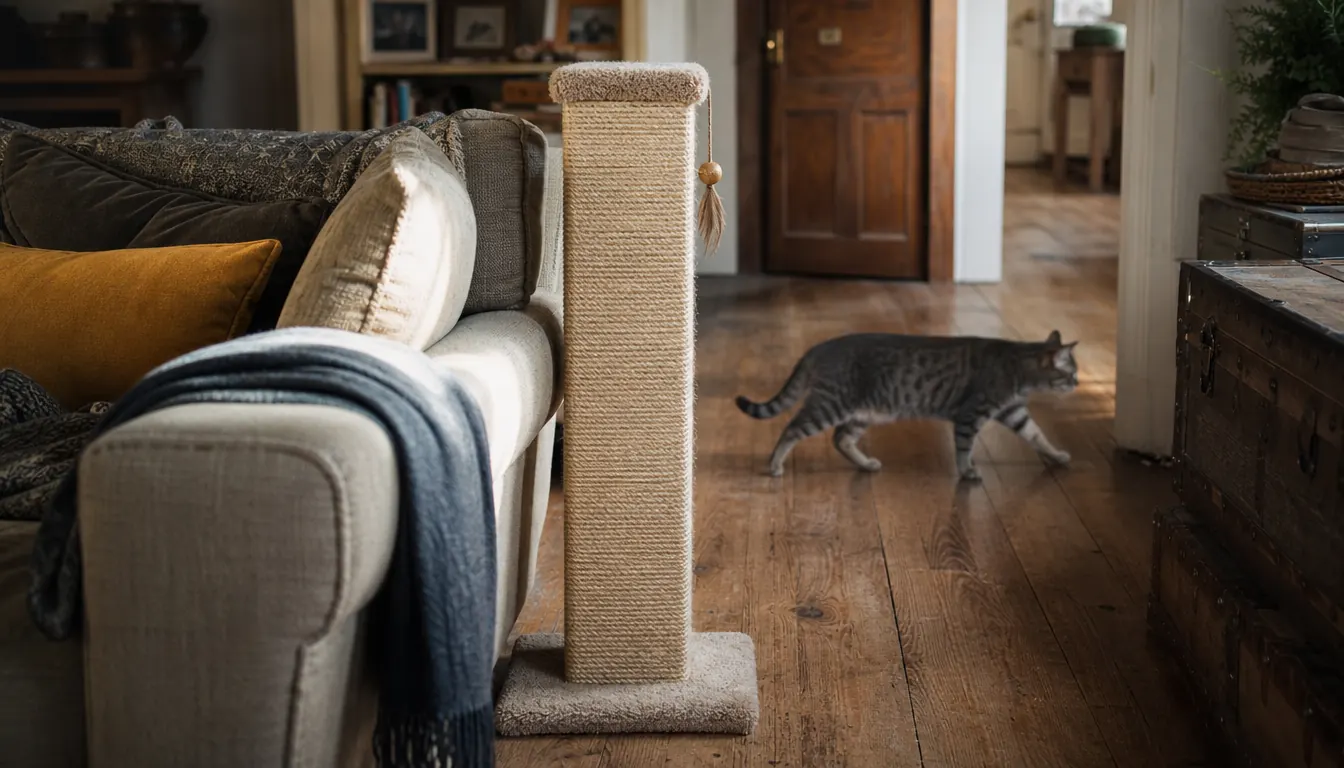
June wore our old carpeted post bare. I am not being cute about it. She had scratched a bald patch straight down to the cardboard tube, and she had started working on the arm of the sofa in the front living room while she was at it. So in January I went looking for a replacement, and it came down to two real options. One was the SmartCat scratching post, a 32 inch sisal tower with a floor-mounted base. The other was the rope scratching post, the kind wrapped in sisal rope around a tube, which is what most people picture when they hear the phrase. I have now lived with the SmartCat for ten months, and I have spent a fair amount of time handling rope posts on the shelf at the feed store in town and reading their listings the way I read everything, with a pencil in my hand.
Here is the short answer. The SmartCat is the better pick for a cat who scratches standing up, and for an owner who does not want to think about the post again. A rope post is the better pick if floor space is the binding constraint, if you would rather re-wrap the same post in a few years than replace it, or if you need a shape the SmartCat does not come in. Everything below is the reasoning, including the three places where I think a rope post genuinely wins.
| SmartCat Scratching Post | A Rope Scratching Post | |
|---|---|---|
| Height | 32 inches, tall enough for a full standing stretch | Usually shorter, often right about the height of a cat on her hind legs |
| Scratching surface | Sisal fabric, a tight flat weave the listing says is made to resist snagging | Sisal rope wound around a tube, a coarser round surface with gaps between the winds |
| Base and tipping | 13.5 pounds on a 16 by 16 inch floor-mounted base. Ours has never tipped | Lighter by nature, so it stands or rocks depending on the base that particular model ships with |
| Cat size range | Listed for all breed sizes, and our fourteen pound cat uses it daily | Varies by model. The small slim ones suit kittens and smaller cats |
| Floor space | 16 by 16 inches of floor, plus room to stretch in front of it | Slim enough to slip into a gap between a bookshelf and a wall |
| Long-term upkeep | Care instructions say hand wash only. The surface is not something you re-wrap | Rope wears, but it can be wound back on and the same post used again |
| Shapes and options | One shape at one height | Corner models, angles, low flat ones, versions with a perch or a toy on top |
| Assembly | Two screws and two dowels. No wall bracket and no drilling | Usually simple as well, often a single bolt up through the base |
| Best for | Cats who scratch standing up, and big cats | Tight rooms, and cats who scratch low or flat rather than up |
The Two Things I Actually Compared, and Why
I want to be clear about what a rope post is, because the two products get talked about as if they were the same item in different packaging, and they are not. The SmartCat post is wrapped in sisal fabric, a tight flat weave that the listing describes as durable and made to stand up to claws with less snagging than a looser wrap. A rope post is wrapped in sisal rope wound around a tube, which gives a coarser, rounder surface with visible gaps between the winds. A cat's claws meet those two surfaces differently. June, who is three and scratches like she is being paid by the hour, digs in on either one. Biscuit, who is nine and fourteen pounds, prefers to lean his whole length against something and pull.
The second difference is height and mass. The SmartCat measures 16 by 16 by 32 inches and weighs 13.5 pounds according to the listing, and it is a floor-mounted piece with nothing to fix to a wall. Most of the rope posts I handled at the feed store were shorter and lighter, in the range where a cat can get her claws up over the top and pull the whole thing toward her. That sounds like a small thing. It is not. A post that a cat can out-reach, or that rocks when she pushes, teaches her that the post is not a good place to put her weight. Then she goes back to the sofa, and you have bought a piece of furniture that only you use.
Ray put the SmartCat together in the time it takes a kettle to boil. The listing says two screws and two dowels, and that is exactly what it is. No brackets, no anti-tip strap, no drilling into a plaster wall in a house older than either of us. I have screwed enough furniture to a stud in this place to appreciate a thing that simply stands there.
Where the SmartCat Wins
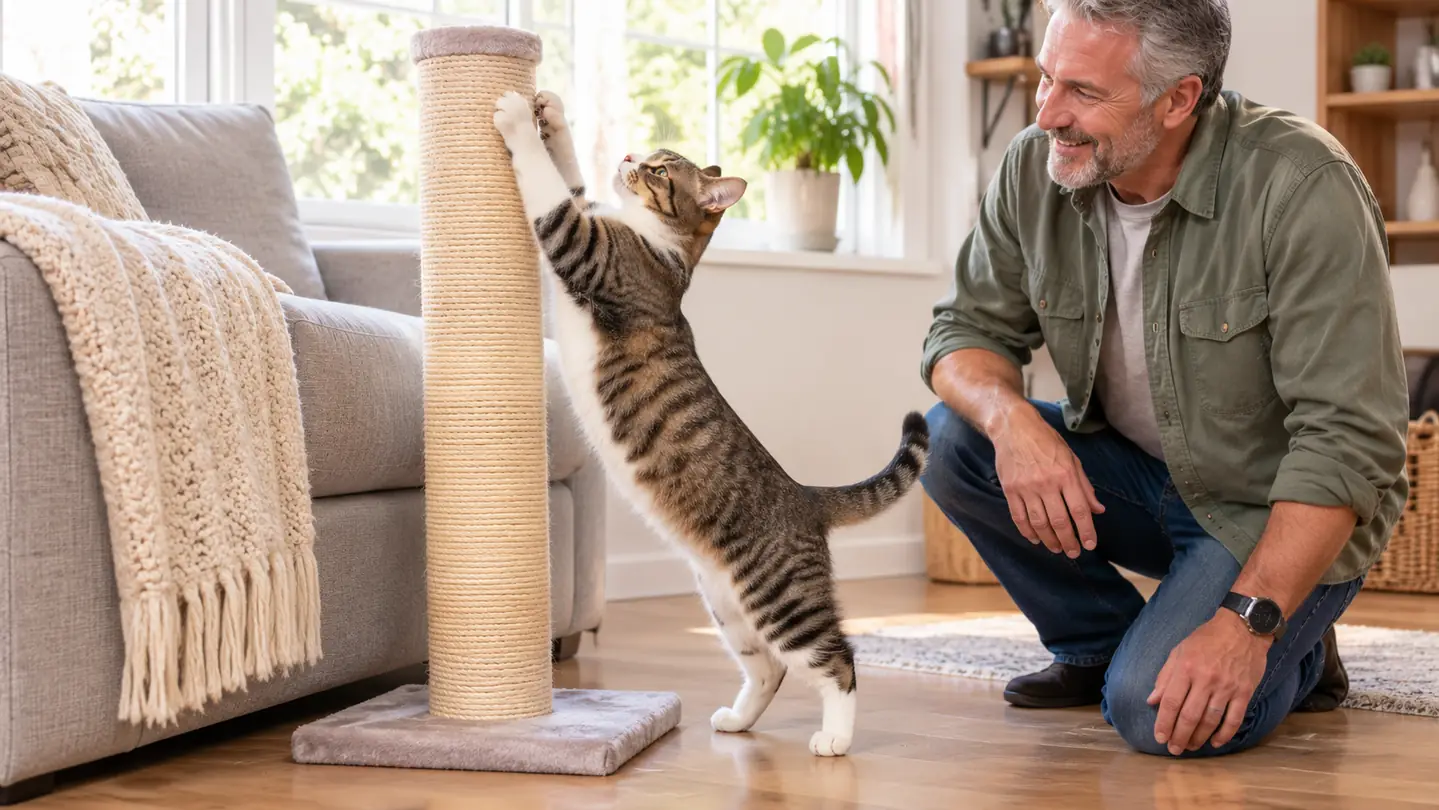
The obvious win is height. Thirty-two inches is enough for a cat to stretch out full length, and both of ours do. June scratches it every day, usually in the morning after she has been fed and is feeling pleased with herself. Biscuit uses it differently. He hooks his claws near the top and walks his front feet downward into a long stretch that gets his shoulders working. On a shorter post he would have to hunch, and hunching is not a stretch.
The less obvious win is that it does not move. The base is 16 inches square and the whole thing is 13.5 pounds, and on our wood floor it sits dead flat. It has never tipped. Not when June launches at it at a dead run from the hallway, and not when Biscuit leans his full fourteen pounds into a stretch on his way past to the water bowl. For a piece of cat furniture that lives in a front room with a window and a walkway through it, that is the whole ballgame. A post that stays put is a post that gets used.
Third, it is quiet and it is plain. It does not chatter across the floor, it does not creak, and it does not look like a cat product. The listing calls the design simple and the finishes neutral, and I would agree with both. Ten months in it looks like a piece of furniture that a cat happens to use, which is more than I can say for the carpeted thing it replaced.
Where a Rope Post Wins
I am not going to pretend this was a clean sweep. Rope posts win on floor space, for one. A slim rope-wrapped post slips into the gap between a bookshelf and the wall, or into the corner of a small bedroom, in a way a 16 inch square tower simply cannot. If the only place in your house for a scratching post is the corner of a narrow hallway, a rope post will fit there and the SmartCat will not. That is not a knock on the taller post. It is just arithmetic.
The second win is upkeep. Sisal rope wears, but it can be re-wrapped. You can buy a coil of rope and wind it back onto the tube, and the post lives again for an evening of your time. The SmartCat's care instructions say hand wash only, and the surface is not something you re-wrap. When it finally goes, it goes. Ten months in, ours shows a dulled patch on the front face where June does her daily work, plus a light fuzz near the top where Biscuit drags his claws down. Both are what a sisal surface is supposed to do, and I expect it will last a good while yet. But I am not under the illusion that it is permanent, and I would not want you to be either.
Third is variety. Rope posts come in corner models, in angled ones, in low wide ones for cats who like to scratch on the flat, and in versions with a perch or a dangling toy on top. The SmartCat is one shape at one height. In a one cat household with one clear preference, that single shape is plenty. In a house like ours, with a nine year old who lies flat and a three year old who climbs, a rope post lets you buy the shape you need instead of the shape that exists.
If your cat scratches standing up, buy the one that does not move under her
The SmartCat scratching post is 32 inches of sisal fabric on a 13.5 pound floor-mounted base, and it goes together with two screws and two dowels. Ten months of daily use in our front room and it has not tipped once.
Amazon See the SmartCat scratching post on Amazon →It has never tipped. Not when June hits it at a dead run from the hallway, and not when Biscuit leans all fourteen pounds of himself into a stretch.
How the SmartCat Has Held Up Since January
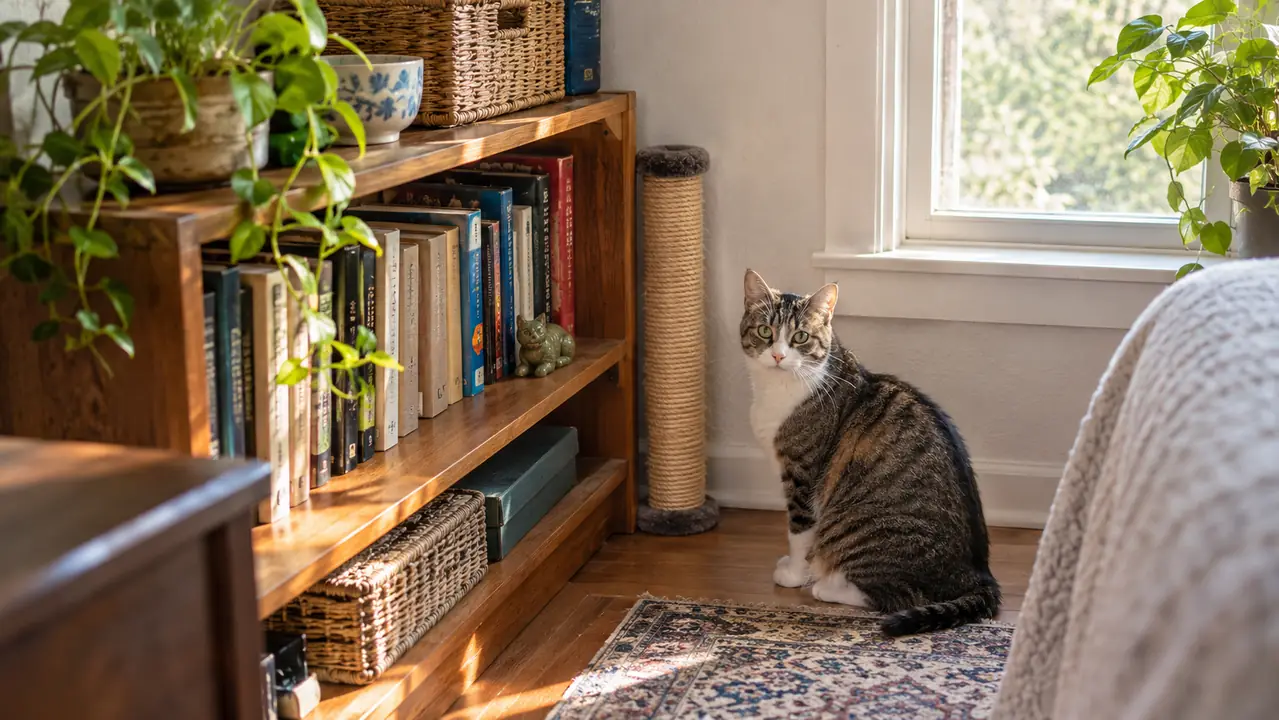
The honest report is that it looks used, because it is used. The front face has a dulled patch where June works at it every morning. There is a soft fringe of loose fiber near the top where Biscuit drags his claws down through a stretch. Neither of those is damage. A sisal surface that shows no wear at all is a sisal surface nobody is scratching, and that would be the real problem.
The base has not split. The dowels have not worked loose. I check it about once a month, because I check everything in this house about once a month whether it needs it or not, and I have not had to tighten a single screw since Ray assembled it. On a floor that is a hundred years old and not perfectly level in any direction, that counts for something.
The thing I actually care about is what the cats did with it. June stopped going for the sofa arm within a few weeks of the post arriving. I am not going to tell you that will happen in your house. Cats are cats, June is one cat, and I am a science teacher rather than a behaviorist. I will tell you what happened in ours and let you weigh it.
What I Liked
- 32 inches of standing height, so a cat can stretch out full length instead of hunching
- 13.5 pounds on a 16 by 16 inch floor-mounted base. Ours has never tipped in ten months
- Two screws and two dowels to assemble, with no wall bracket and no drilling
- The tight sisal fabric weave has not snagged a claw once, unlike the carpeted post it replaced
- Plain enough that it does not read as a cat product in a front room
Where It Falls Short
- It takes a real 16 by 16 inch square of floor, which rules out tight corners and narrow hallways
- Care instructions say hand wash only, and the surface cannot be re-wrapped the way rope can
- One shape at one height, so there is no corner version and no low flat version
- At fourteen pounds, Biscuit uses it as a stretching station rather than a post to climb, so it is not furniture for a cat who wants to go up
Setup Notes That Actually Matter
Put it where the scratching is already happening. Ours stands at the end of the sofa in the front living room, which is precisely where June had been working on the upholstery. A post in a back bedroom that a cat only passes at night does not get used the same way. That is not a training insight, it is just placement, and it is the difference between a post with a worn face and a post that needs dusting.
Second, set it on a flat floor. The SmartCat is a floor-mounted piece with no wall bracket, which is exactly what I wanted in a house with plaster walls I have no intention of drilling. But a floor-mounted tower only stands as well as the floor beneath it. On our wood floor it sits flush. If yours rocks when you press the top, move it to a level spot rather than shimming it, because a post that wobbles under a cat is a post she will stop trusting.
Third, measure before you order. Sixteen by sixteen is not enormous, but it is a real square of floor and it needs clearance in front for a cat to stretch into. I measured our spot with a tape first, a habit I picked up from years of redoing rooms one at a time, and I would do it again. If the tape says the only available spot is a corner gap, this is not the post for that spot, and no amount of wanting it to fit will change that.
Who Should Buy Which
Buy the SmartCat if you have a cat who scratches standing up, if you have a big cat, or if you have a post that keeps tipping and you are tired of it. Buy it if the post has to live in a room you actually sit in, because it is plain enough to live with. Buy it if you would rather not think about re-wrapping anything ever. In our house it has ended up serving both cats, which I did not expect: June treats it as a scratching post and Biscuit treats it as a stretching station on his way through the room.
Buy a rope post instead if floor space is the binding constraint, if you want a post you can re-wrap in a few years rather than replace, or if you need a shape the SmartCat does not come in. If your cat scratches horizontally on the floor rather than up on a vertical surface, a tall tower is not aimed at her and a low or angled rope post may suit her better. And if you are honestly not sure which kind of scratcher your cat is, the lower-risk experiment is the smaller post. You will learn more from watching which one she uses for a fortnight than from anything I can tell you in an article.
One tall post, ten months in, still standing at the end of the sofa
32 inches of sisal fabric on a 13.5 pound floor-mounted base, assembled with two screws and two dowels, listed for all breed sizes. Ours has not tipped once and June has not gone near the sofa arm since. If your cat's current post has a wobble in it, this is the fix I would try first in my own house.
Amazon See the SmartCat scratching post on Amazon →