
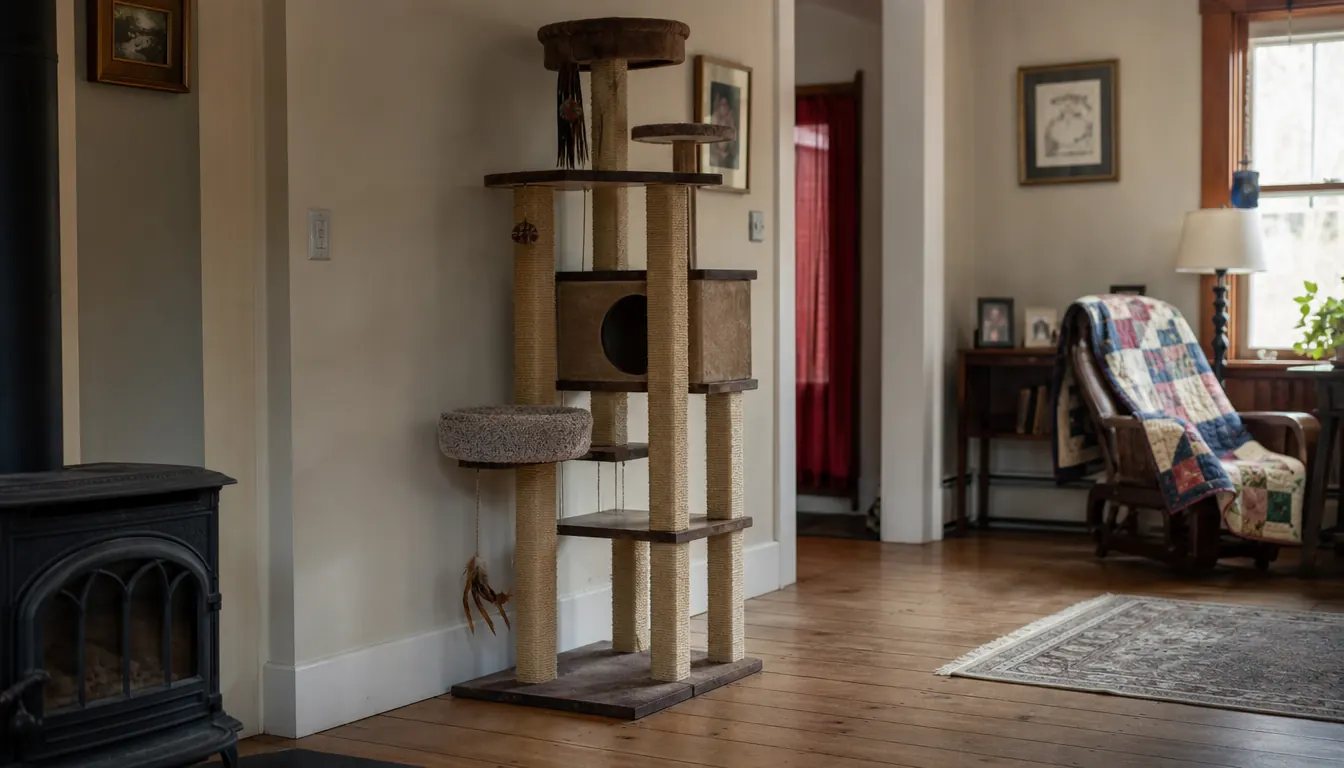
The photo that sold me on the Heybly was not a product shot. It was a customer picture of a big orange cat lying flat on the top platform with his chin hanging over the edge, completely unreachable. I have one of those at home. Biscuit is nine, about fourteen pounds, and has firm opinions about how much effort a nap should require. What that photo did not tell me, and what none of the reviews I read that night told me either, is that this thing is thirty-five pounds of engineered wood that arrives flat in a box and takes two adults most of an afternoon to stand up.
So here is the version I would have wanted before I ordered. The Heybly Heavy-Duty Cat Tree is a real piece of furniture, not a carpet-covered post with ambitions. It is also a tall, narrow-footprint object that leans if you do not anchor it, and there are three or four details I would change tomorrow if I could. I am not a vet and I am not a cat behaviorist. I am a middle school science teacher with two indoor cats and a husband who owns a level, and this is what eight months in the corner of our den has actually looked like.
The Quick Verdict
Sturdy, tall and genuinely sized for a big cat, as long as you are willing to put a screw in a wall stud and accept that the top perch belongs to whoever gets there first.
Amazon Check Today's Price →If You Have a Big Cat and a Wall Stud, Start Here
The five-level Heybly tree is the first tall tower that gave our fourteen pound cat a platform wide enough to lie across. Check the current listing for the exact dimensions and what comes in the box before you pick the corner.
Amazon Check Today's Price on Amazon →What Nobody Puts in the Reviews
The listing gives you the important numbers up front, and I read them carefully: 64.17 inches tall, a footprint of 21.65 by 17.72 inches, and a shipping weight of 35.49 pounds. That last number is the one I underestimated. Thirty-five pounds of engineered wood and hardware in one carton is not a package you carry up a flight of stairs under one arm. Ours arrived intact. I opened it in the garage and carried the pieces in by the armful, which was a better plan than dragging the whole box through the house.
The other thing nobody mentions is that a tall cat tree is a lever. The Heybly has a widened frame and a wide base, and the base really is broader than the old carpeted post June had shredded, but sixty-four inches of anything will want to tip if a fourteen pound cat launches at the top perch from a running start. Ray screwed a plain furniture anti-tip strap from the top section into a wall stud. That strap came from the hardware store, not from the box, and as far as I can tell the listing does not include one. If you rent, or if you have plaster walls you would rather not put a screw into, decide how you feel about that before you order rather than after.
I also want to be straight about the ratings, because I know people shop by them. The listing sits a little above four stars out of five across a very large pile of reviews. I understand why it is not higher and I understand why people buy it anyway, and both of those things are in this piece.
One piece of advice that has nothing to do with cats: measure the corner first. I taped out 21.65 by 17.72 inches on the den floor and stood in it before I ordered, which sounds fussy and took four minutes. It also told me the tree would fit beside the woodstove without blocking the door to the back hall, which is the kind of thing you cannot tell from a listing photo no matter how long you look at it.
How I've Used It
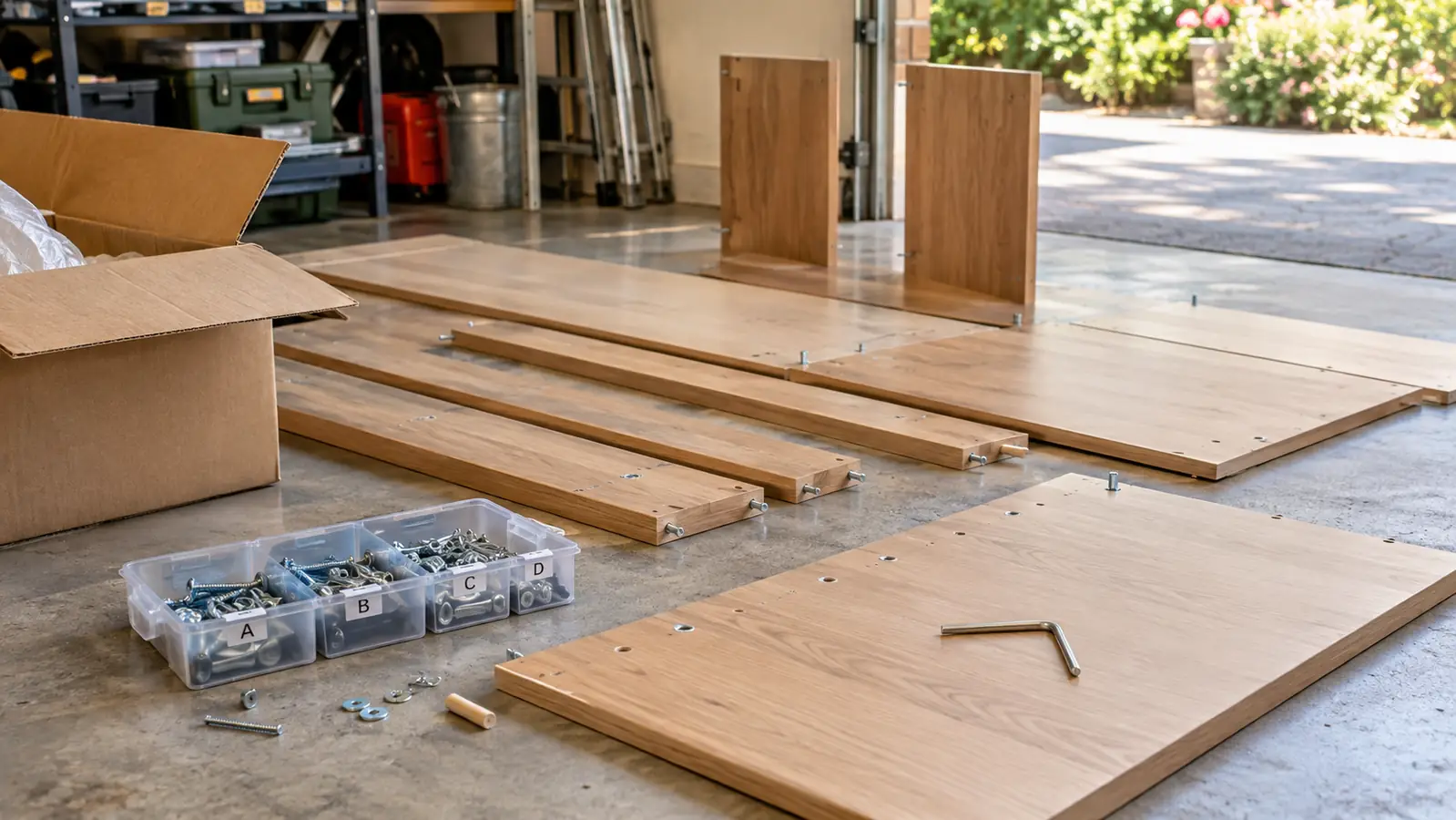
We assembled ours on a Saturday afternoon in March, in the corner of the den in the newer back addition, near the woodstove. Ray did the drilling and I did the reading and the leveling, which is how we divide most things. The instructions are mostly pictures with small print, and the hardware comes in a segmented tray with the parts lettered. Start to finish it took us about an hour and a half, and that includes the ten minutes I spent looking for a washer I had already used.
The build is not complicated, but it is repetitive. Five levels means a lot of the same motion, and by the third platform your wrist knows exactly what the hex key feels like. Lay the pieces out by level on a hard floor and it goes quickly. Pile everything in one heap on carpet and you will be back in the box twice looking for the right bolt.
Two people make this much easier, though one patient person can do it. The reason I would not do it alone is the top section, which is long and awkward to hold level while you drive screws. That is a second set of hands problem, not a strength problem.
Once it was standing, we walked it into the corner and I put a level on the two front legs. The den floor is wood, and nothing in this old house is level in any direction, so I shimmed one corner with a folded piece of card stock. Then Ray put the strap into the stud. That last step is the one I would not skip, and it is the one I would do before the cats are allowed anywhere near the top.
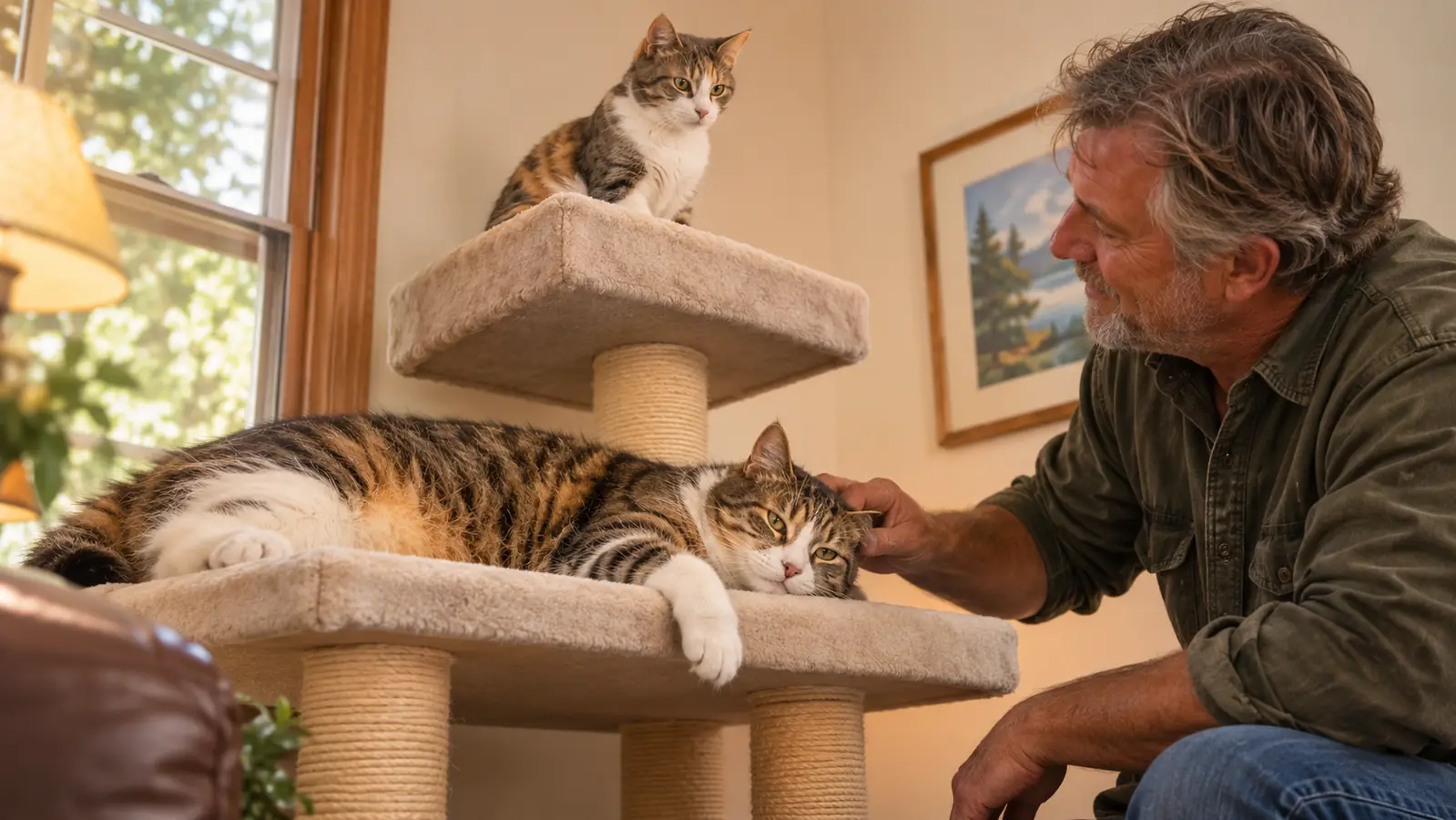
The first evening, Biscuit walked the whole thing from the bottom platform up to the second level, sat down, and looked at me like I had built him a staircase and then expected him to climb it. June was on the top perch before I had put the tools away. That is roughly how it has gone ever since.
Eight Months In: What Held Up and What Didn't
June is three, about eight pounds, and climbs anything vertical. She has claimed the top square perch, the one the listing describes as the panoramic view spot, and she sleeps up there most afternoons with one paw over the edge. Biscuit is the reason we bought this in the first place. He is not going to scramble up five levels, and he does not have to, because the lower pentagonal platform measures 17.7 by 21.7 inches and he can lie across the whole of it without any part of him hanging off.
That lower platform is the number I would put in the headline if I were writing the listing. For a big, lazy cat the usable flat area is the whole product, and plenty of tall trees have perches a fourteen pound cat drapes over rather than sits on. This one does not. It is the single reason the tree stayed in the den instead of going out to the barn sale pile.
The condo gets used, just not by June. Biscuit naps in it some afternoons, mostly in the colder weeks when the woodstove is going and the den is the warmest room in the house. He has to duck a little going in. He does it anyway. I would call the condo adequate for a big cat and roomy for a small one, and I would not call it generous.
The scratching surfaces are where this thing earns its keep. Seven sisal posts and one scratching board is a lot of real estate, and it means there is a post within reach wherever a cat lands. Eight months in, June has worn exactly one of them down to the wood on one side. The other six look nearly new. That is not a knock on the posts. It tells you a cat picks a spot and commits to it, and the value of having seven is that she found one she liked without touching the arm of the sofa.
The pom-poms and the sisal rope toys are still attached. June bats at them when she is in a mood. Biscuit has never once acknowledged them. I rehung one pom-pom after it came loose, which took about a minute and a half.
What has not been used: the top perch by Biscuit, ever, and one of the middle levels by either of them. That middle level is not a defect, it is a route, and June uses it as a stepping stone on the way up. But if you are buying this expecting two cats to occupy two separate high perches at the same time, know that in our house the top belongs to one cat and everyone else negotiates.
Getting down is worth a mention for anyone with a hardwood floor. June does not climb down, she drops, and from the top perch that is a real fall. She lands it every time and has never so much as limped, but if you have an older or heavier cat, watch how yours handles the descent before you decide the top is a good idea. That is not a warning about this product in particular. It is a warning about height in general.
Biscuit is fourteen pounds and he sleeps on the lower platform, which the listing gives as 17.7 by 21.7 inches. That is the number that decided this purchase for us, and it is not the number in the title.
The Parts I'd Change
The footprint is narrow for the height. Roughly 21.65 by 17.72 inches on the floor is a small base for a 64 inch tower, and the widened frame does most of the work of keeping it honest. It has not tipped and I do not expect it to, because it is strapped to a stud. Unstrap it and I would feel differently, especially with a cat who launches.
The faux fur covering is soft, the cats like it, and it collects everything. Lint, cat hair, the fine dust that comes off the sisal, all of it lives in that nap. A rubber glove and the upholstery tool on the vacuum get it back to rights, and I do it about once a month. If you are not going to vacuum a cat tree, buy a plainer one.
The hardware is the part that feels least like furniture. The bolts are fine, they have held, and nothing has loosened enough to matter. But the bolt sequence is the reason assembly takes as long as it does, and I went around and re-tightened everything at the two month mark out of habit rather than need. If I could change one thing it would be the instruction sheet, which shows the parts but not always the order clearly. We backed up twice because of it.
The scratching board sits low on the frame, near the base, and neither cat has touched it. I am not sure why. The posts are right there at nose height and the board is not, and cats in our house scratch standing up. It may be the opposite in yours. That is the trouble with writing this kind of piece honestly: half of what I can tell you is really a report on June.
And the plain limitation: this is a tall object in a room. In a small apartment it will dominate whatever corner it lands in. In our den, which is a decent sized room, it reads as furniture rather than clutter, which is the most I ever ask of a cat tree.
What I Liked
- The lower platform is genuinely wide enough for a big cat to lie flat across
- Seven sisal posts plus a scratching board, so there is always one within reach
- Widened frame and wide base hold steady once it is strapped to a stud
- The top perch is high and open, which is what a climber actually wants
- Sisal has held up through eight months of daily scratching with no fraying
Where It Falls Short
- Ships without an anti-tip strap, and at 64 inches tall it wants one
- The condo is snug for a fourteen pound cat
- Faux fur holds hair and sisal dust and needs regular vacuuming
- The instruction sheet is unclear on sequence in a couple of spots
- Narrow footprint relative to the height
Who This Is For
This is for a household with at least one cat who wants altitude and at least one cat who wants a wide, flat, low place to lie down. That combination is exactly what the Heybly is built around, and it is why ours has stayed in the den. If you have a climber and a lap cat, one purchase covers both of them.
It is also for someone willing to put a screw in a wall. That is the price of a tall tree in a house with cats in it, and I would say the same about any tower over about four feet. If you can do that, the build is an afternoon and then you are done with it.
Who Should Skip It
Skip it if your cat is a senior who has stopped jumping, or if you have one cat and no interest in a five level tower. Biscuit is nine and slower on the stairs than he used to be, and he uses two levels of this tree. That is fine, we have the room, and the lower platform is worth the footprint by itself. But if low and wide is all you need, a low and wide product is the better answer. Anything about a cat's health, weight or joints is a question for your own vet, not for me.
Skip it if the tree is going in a rental where you cannot anchor it, or against a plaster wall you would rather not drill. Skip it if you are not going to vacuum the faux fur, because it will show. And skip it if you want your furniture to match, because this is a cat tree and it looks like a cat tree.
The Tree That Finally Fit a Fourteen Pound Cat
Eight months in, the sisal has held, the frame is still square against the wall, and Biscuit still sleeps on the lower platform every afternoon. If that sounds like your house, the current listing is the place to check the dimensions and the weight before you commit to a corner.
Amazon Check Today's Price on Amazon →